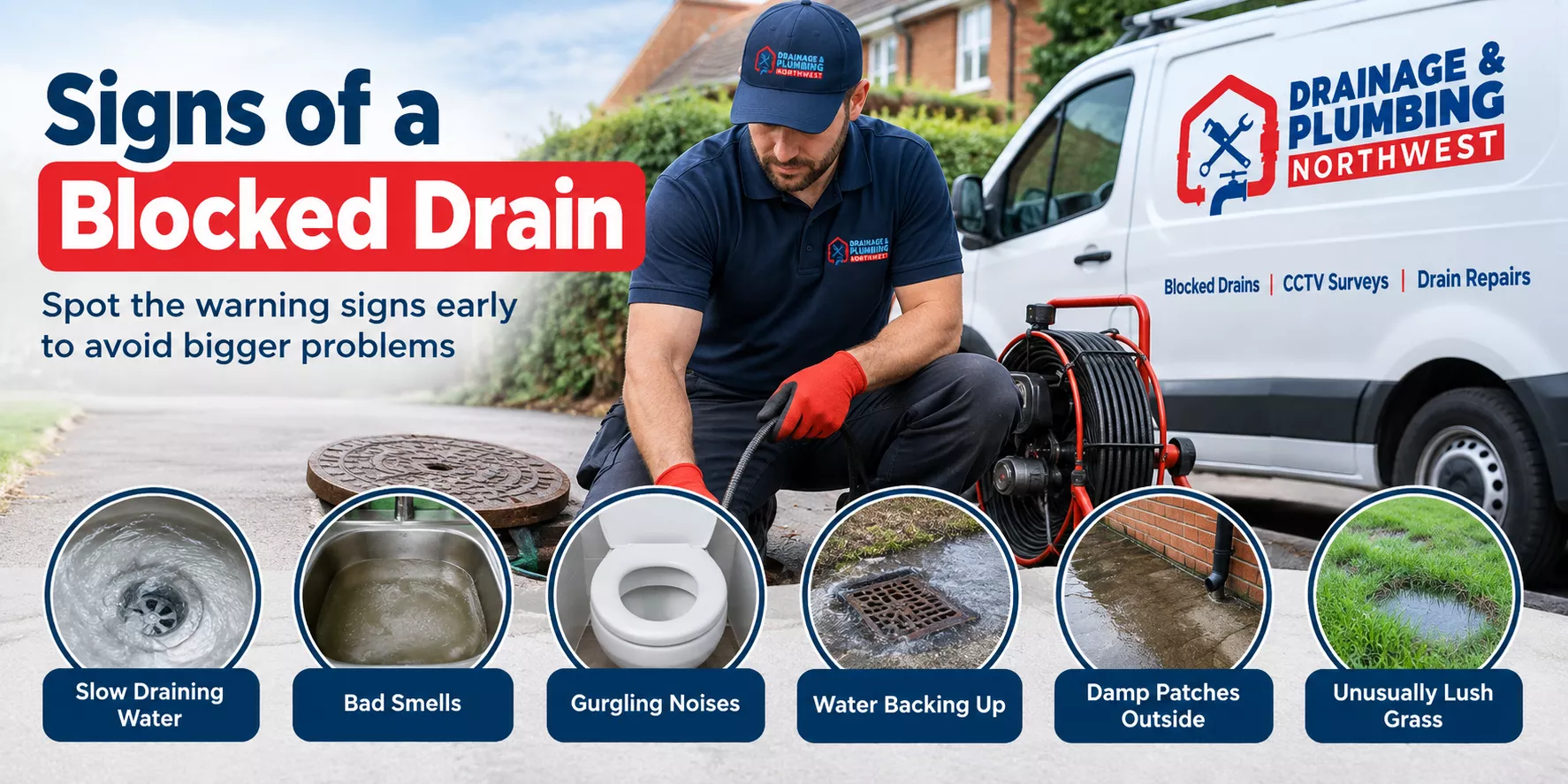
Blocked drains can affect sinks, toilets, showers, outside drains and underground pipework, with common warning signs including slow or stopped drainage, gurgling noises, foul odours, rising water and repeated backups. Causes can range from hair, grease, food waste, wipes, leaves and trapped debris to deeper problems such as tree-root intrusion or damaged drainage. Minor accessible blockages may sometimes be cleared locally, but persistent, severe or recurring problems often need professional diagnosis and suitable equipment.
Professional drain unblocking across the North West and Greater Manchester can include manual clearance, drain rodding, high-pressure water jetting, CCTV drain surveys and, where necessary, repairs, relining or replacement. CCTV inspection can help locate difficult or recurring faults, while clean-water testing confirms whether normal flow has been restored. For urgent problems such as sewage backups, overflowing drains or serious flooding risks, 24/7 emergency drainage support may be available across local service areas including Manchester, Bolton, Salford, Stockport, Bury, Oldham, Rochdale, Tameside, Trafford and Wigan.
What Is a Blocked Drain?
A blocked drain is an obstruction, build-up, or structural defect within a drainage pipe or system that restricts or completely stops wastewater, sewage, rainwater, or surface water from flowing away normally. It can affect foul drains, surface water drains, combined drains, land drains, drainage fields, private household drains, shared drains, or public sewers. Common causes include fat, oil and grease, food waste, wet wipes, sanitary products, tree roots, scale, silt, external debris, collapsed pipes, displaced joints, poor installation, and incorrect gradients.
Important signs, risks, and solutions include:
- Signs: Slow-draining sinks, baths or showers, difficult toilet flushing, rising water, foul smells, gurgling noises, backflow, overflowing gullies or manholes, and localised flooding.
- Risks: Sewage contamination, internal flooding, structural damage, health hazards, environmental pollution, and harm to rivers, watercourses, or wildlife.
- Diagnosis: CCTV drain surveys, dye testing, drain rods, electromagnetic sondes, and flow or pressure testing can help locate the blockage and identify its cause.
- Treatment: Minor blockages may be cleared with plunging or rodding, while severe cases may require high-pressure water jetting, root cutting, excavation, pipe replacement, or pipe relining.
- Prevention: Flush only pee, poo, and toilet paper; keep wipes, sanitary products, fat, oil, grease, food waste, and debris out of drains; and maintain gullies, manholes, septic systems, and older pipework regularly.
- Responsibility: Private drain blockages are generally the property owner’s responsibility, while qualifying public sewer problems may fall to the relevant water company.
In simple terms, a blocked drain is a drainage system that cannot carry water or waste properly because its normal flow has been restricted. Early identification and correct treatment can prevent backflow, flooding, pollution, property damage, and costly recurring drainage problems.
How Does a Drain Blockage Affect Wastewater Flow?
A drain blockage affects wastewater flow by narrowing or completely closing the available path through a pipe. This reduces pipe capacity, slows wastewater movement, and can cause solids and debris to settle and build up further. As the restriction worsens, water may drain slowly, pool in fixtures, raise water levels, trap air, and produce gurgling or bubbling sounds. In severe cases, wastewater can reverse direction, back up through toilets, sinks, showers, or other connected fixtures, and eventually overflow from gullies, inspection chambers, or manholes.
The most important effects include:
- Reduced flow rate: Wastewater moves more slowly because the pipe has less available space.
- Pooling and standing water: Water may remain in sinks, baths, showers, gullies, or drainage fields.
- Gurgling and trapped air: Restricted flow disturbs air movement inside the drainage system.
- Rising water and backflow: Wastewater can build up behind the obstruction and return through lower fixtures.
- Overflow and flooding: Severe blockages can cause gullies, manholes, or internal fixtures to overflow.
- System-wide disruption: A shared or main drain blockage may affect several fixtures or properties at once.
- Different drain impacts: Foul drains may back up with sewage, surface water drains may cause ponding or flooding, and drainage fields may become saturated or boggy.
- Common causes: Fat, oil, grease, wipes, roots, scale, silt, debris, collapsed pipes, displaced joints, and poor gradients can all restrict wastewater movement.
Is a Blocked Drain Different From a Blocked Sewer?
A blocked drain and a blocked sewer differ mainly in scope, location, symptoms, and responsibility. A blocked drain is usually a localised problem affecting one fixture, one pipe run, or one property, while a blocked sewer affects a wider underground wastewater network and may cause several fixtures or neighbouring properties to back up at the same time. Both can be caused by fat, oil, grease, food waste, wet wipes, sanitary products, nappies, and other unsuitable materials entering the system.
Key differences include:
- Scope: A blocked drain usually affects one sink, shower, toilet, or property; a blocked sewer may affect several fixtures or properties.
- Location: Drain blockages are often within private pipework, while sewer blockages are more likely to involve shared or public drainage.
- Symptoms: Drain blockages commonly cause slow drainage, bad smells, or localised backflow; sewer blockages can cause widespread sewage back-up, overflowing manholes, or flooding.
- Diagnostic clues: If neighbours are unaffected and only one property has problems, the blockage is more likely private. If several properties are affected, a shared or public sewer may be involved.
- Responsibility: Private drain blockages are generally the property owner’s responsibility, while qualifying public sewer blockages are usually handled by the relevant water and sewerage company.
- Action: Contact a plumber or drainage contractor for a suspected private blockage, and report suspected public sewer problems or external sewage leaks to the relevant water company.
In simple terms, a blocked drain is usually a local problem within private drainage, whereas a blocked sewer is a wider network problem that can affect multiple fixtures or properties at once.
What Are the Signs of a Blocked Drain?
The most common signs of a blocked drain are slow or stopped drainage, gurgling or bubbling noises, foul or eggy smells, rising water, and wastewater backing up through sinks, baths, showers, or toilets. Slow drainage usually points to a partial blockage, while water that does not drain at all suggests a more severe obstruction. Unusual smells often come from trapped food, grease, hair, dirt, or other organic waste decomposing inside the pipe, while gurgling sounds are typically caused by trapped or displaced air.
The scale of the symptoms can also help identify where the blockage is. If only one fixture is affected, the problem is more likely to be localised. If several fixtures are slow, gurgling, or backing up at the same time, the blockage may be in a wider drain or sewer connection. Rising water in gullies, inspection chambers, or manholes can indicate an external blockage, and severe cases may lead to overflow, flooding, or pipe damage. In simple terms, the warning pattern is slow drainage → unusual smells or sounds → rising water → backflow → overflow or flooding.
1. Slow-draining water
Slow-draining water usually means that the flow through a sink, basin, shower, or bath waste pipe is being restricted. Common causes include hair, soap scum, gunk, trapped waste, and sludge collecting around the stopper or inside the P-trap beneath the sink. If only one fixture is draining slowly, the blockage is likely to be localised to the stopper, trap, or nearby waste pipe. Removing the stopper, clearing hair and debris, cleaning the P-trap, or using a plunger may restore normal drainage. Minor organic build-up may also respond to baking soda, vinegar, and a hot-water flush.
The number of affected fixtures is an important diagnostic clue. One slow sink or shower usually points to a local problem, while several drains throughout the home draining slowly at the same time may indicate a blockage further downstream in a shared drain or wider drainage system. Persistent or recurring slow drainage after basic cleaning suggests that the obstruction may be deeper within the pipework. In that case, further investigation may be needed to locate and remove the underlying blockage.
2. Gurgling or bubbling pipes
Gurgling or bubbling pipes usually happen when air is trapped or displaced because wastewater flow or drainage ventilation is restricted. Common causes include partial blockages from hair, soap scum, grease, food waste, blocked roof vents, damaged P-traps, or deeper sewer-line problems. One noisy fixture often suggests a local issue, while several fixtures gurgling together can indicate a shared drain or main sewer blockage.
Important aspects include:
- Trapped air: Restricted wastewater flow forces air pockets through water, creating gurgling or bubbling sounds.
- Partial blockage: Hair, soap scum, grease, food waste, and debris can narrow the pipe and disturb normal flow.
- Blocked vent pipe: Leaves, nests, ice, or debris can restrict airflow and create pressure changes in the drainage system.
- Damaged P-trap: A broken or incorrectly configured trap can disrupt the water seal and airflow.
- Multiple fixtures affected: If several drains gurgle at the same time, the problem may be in a shared drain or main sewer line.
- Cross-fixture reaction: A toilet gurgling when a sink drains, or another drain bubbling when the toilet is flushed, can indicate a downstream restriction.
- Possible severe causes: Tree-root intrusion, deep sewer clogs, or collapsed pipework may cause persistent system-wide gurgling.
- When to act: Ongoing gurgling combined with slow drainage, rising water, or wastewater back-up should be investigated promptly.
In simple terms, gurgling or bubbling pipes are an early warning that air and wastewater are not moving normally through the drainage system.
3. Bad or sewage-like smells
Bad or sewage-like smells usually indicate that foul gases are escaping from the drainage or septic system. Common causes include a dry P-trap or U-bend, blocked or poorly configured vents, failed toilet seals, dirty or partially blocked drains, cracked pipework, and full septic tanks. Hair, grease, soap scum, food waste, sludge, and other organic material can decompose and encourage bacterial activity, producing foul or rotten-egg odours. In septic systems, excessive sludge, poor ventilation, unsuitable waste, and overdue emptying or desludging can also contribute to persistent smells.
The location and timing of the odour can help identify the cause. Smells near rarely used fixtures may point to a dry trap, odours around a toilet base may indicate a failed seal, and smells behind walls or in basements can suggest damaged pipework. If sewage-like odours occur alongside slow drainage, a slow toilet flush, wastewater backup, or repeated blockages, the problem is more likely to involve restricted drainage or a deeper system fault and should be investigated promptly.
4. Rising toilet water
Rising toilet water usually means wastewater is not leaving the bowl normally. The most common cause is a partial blockage caused by toilet paper, wet wipes, sanitary products, non-flushable items, or mineral build-up. Mechanical faults with the flapper valve, float, fill valve, or flush handle can also weaken the flush and contribute to rising water or slow drainage.
The most important signs and actions are:
- Water rises then drains slowly: Often indicates a partial blockage restricting wastewater flow.
- Water stays high or approaches the rim: Suggests a more severe blockage and an increased overflow risk.
- Weak flush: May be caused by a faulty flapper, float, fill valve, or flush handle.
- Other fixtures back up: Rising water in the toilet alongside sink or shower back-up may indicate a shared drain or main sewer blockage.
- Gurgling sounds: Can indicate trapped air and restricted flow deeper in the drainage system.
- Immediate action: If the bowl is close to overflowing, stop the incoming water supply and do not flush again.
- Minor blockage: A flange plunger may clear a local obstruction.
- Persistent symptoms: Repeated rising water, slow drainage, gurgling, or multiple affected fixtures may require professional drain investigation.
5. Water backing up into another fixture
Water backing up into another fixture usually means wastewater is being blocked in shared pipework, a downstream drain, or the main sewer line. When flow is restricted, wastewater can be forced back through another connected or lower-level fixture, such as a sink, bath, shower, toilet, or floor drain. Back-up between two nearby fixtures often points to a shared branch blockage, while several independent fixtures backing up together suggests a deeper main drain or sewer obstruction.
Hair, grease, soap residue, and debris can cause local restrictions, but if flushing a toilet makes water rise in a shower or floor drain, the blockage is likely further downstream. Stop using water if back-up is active to reduce the risk of overflow or flooding. If clearing a local trap does not solve the problem, professional drain clearing or CCTV inspection may be needed to locate the obstruction.
6. Overflowing outside drains
Overflowing outside drains usually mean water cannot move freely through the external drainage system because of a blockage or structural restriction. Common causes include leaves, silt, grease, soap residue, building waste, tree roots, and damaged or collapsed pipework. Warning signs often appear together, especially slow drainage, foul smells, gurgling, standing water, and rising water levels in connected sinks, baths, showers, or toilets.
Key aspects to check include:
- Pooling or standing water: Suggests the gully or downstream pipe is restricted.
- Several fixtures affected: Points to a wider external or shared drainage blockage.
- Overflow during rain: May indicate restricted surface-water drainage.
- Overflow during household water use: Can suggest a foul-water blockage further downstream.
- Foul smells or gurgling: Often indicate trapped waste, decomposing material, or displaced air.
- Repeated overflow: May point to tree roots, hardened deposits, or damaged pipework.
- Minor blockage: Visible debris may sometimes be removed and the drain flushed or mechanically cleared.
- Persistent overflow: May require professional drainage inspection, while shared or public sewer issues may need to be reported to the relevant water company.
7. Several drains affected together
When several drains are affected together, the problem usually lies in shared or main drainage rather than in separate local clogs. Multiple sinks, showers, baths or toilets draining slowly, gurgling or backing up at the same time can indicate a blockage in a shared branch pipe, vertical stack, main drain or sewer line. Common causes include tree roots, grease build-up and unflushable items, which restrict wastewater flow and can force water back into the lowest connected fixtures.
The pattern of affected drains helps locate the problem: several fixtures in one room may point to a shared branch, while issues across bathrooms, kitchens and lower-level drains are more likely to involve the main drainage system. Pooling water in an outside gully, inspection chamber or manhole can also indicate a downstream blockage. If several drains are backing up, reduce water use and avoid flushing toilets to limit the risk of sewage overflow.
8. Recurring blockages
Recurring blockages usually mean the immediate clog has been cleared, but the underlying cause remains. Persistent grease, oil, scale, wet wipes, sanitary products, tree-root intrusion, poor pipe gradient, cracks, misaligned joints, sagging sections or collapsed pipework can all cause waste to collect repeatedly in the same place. If a blockage returns quickly after clearing, affects several fixtures or keeps appearing in the same location, it is more likely to be a deeper drainage problem than a simple local clog.
Important signs and actions include:
- Rapid recurrence: Suggests the original cause has not been removed.
- Same-location blockages: May indicate a structural defect, root intrusion or persistent build-up.
- Several fixtures affected: Can point to a wider shared or main drainage problem.
- Slow drainage, gurgling or odours: Often indicate that restriction remains inside the system.
- Wastewater backing up: Suggests a more serious downstream obstruction.
- CCTV drain survey: Can locate cracks, roots, misalignment, collapsed sections and repeated accumulation points.
- Long-term treatment: May involve high-pressure jetting, root removal, pipe repair, replacement or relining.
- Prevention: Avoid fats, oils, grease, wipes and sanitary products, and investigate recurring slow drainage early rather than repeatedly clearing the same blockage.
What Causes Blocked Drains?
Blocked drains are usually caused by waste, debris or structural problems restricting the inside of pipework. Common indoor causes include fats, oils and grease, food scraps, coffee grounds, hair, soap scum, wet wipes, sanitary products, excess toilet paper and small foreign objects. Outside drains are often blocked by leaves, soil and silt, while deeper problems can come from tree roots, cracked pipes, collapsed sections or misaligned joints.
Many blockages form gradually as materials combine: grease coats the pipe, then catches food, hair, wipes or soap until wastewater flow becomes restricted. Early signs include slow drainage and gurgling, while severe blockages can cause back-up or overflow. Prevention involves keeping grease, food waste, wipes and other unsuitable items out of drains, using hair catchers, and keeping outside gullies clear of debris.
What Causes Indoor Drain Blockages?
Indoor drain blockages are mainly caused by grease, food waste, hair, soap residue, wet wipes, thick toilet paper and hygiene products building up inside household pipework. These materials can stick to pipe walls, collect in bends, tangle together or expand, gradually narrowing the drainage route and slowing wastewater flow. Structural issues such as sagging pipes or rough older cast-iron pipework can also create areas where debris repeatedly becomes trapped.
The main causes vary by fixture:
- Kitchen sinks: Fats, oils and grease, rice, pasta, coffee grounds and vegetable peelings.
- Showers and baths: Hair combined with soap scum, dirt and other residue.
- Toilets: Wet wipes, thick multi-ply paper, cotton products and hygiene items.
- Sagging pipes: Low sections can hold water and allow debris to settle.
- Older cast-iron pipes: Rough internal surfaces can catch paper and waste more easily.
- Early warning sign: Slow drainage often indicates that material is already accumulating before a complete blockage develops.
What Causes Underground and Outside Drain Blockages?
Underground and outside drain blockages are mainly caused by outdoor debris, household waste and structural pipe problems restricting water or wastewater flow. Outside drains commonly become blocked by leaves, twigs, mud, soil, silt, moss, grass and garden clippings, especially during heavy rain when debris is washed into gullies and low-flow areas.
Underground foul drains are often affected by fats, oils and grease, food scraps, coffee grounds, wet wipes, thick toilet paper, hair, soap, toothpaste residue, bath-product particles, cotton buds and small foreign objects. These materials can harden, expand, snag in bends or bind together, gradually narrowing the pipe and creating compound blockages.
Structural problems can make underground blockages more serious or recurring. Tree roots can enter through cracks or loose joints, damaged or collapsed pipes can restrict the drainage route, and poor pipe gradients can slow wastewater enough for solids to settle. Bends and corners also provide natural accumulation points where waste can collect.
Common warning signs include slow drainage, foul smells, several fixtures draining poorly, standing water and overflowing outside gullies or inspection chambers. Persistent or repeated blockages may indicate a deeper structural fault rather than a simple build-up of debris.
Where Can a Drain Become Blocked?
A drain can become blocked at almost any point in the drainage system, from internal fixtures and local waste pipes to outdoor gullies, underground drains, shared sewers and public sewer networks. In kitchens, blockages often form in the sink U-bend or horizontal waste pipe, while showers and baths commonly clog at the drain opening or trap. Bathroom basins may block around the pop-up waste or U-bend, and toilets can obstruct in the porcelain trapway or immediate soil pipe.
Outside the property, gullies, yard drains and rainwater drains can become blocked by leaves, moss, silt and storm debris. Deeper underground, lateral drains, main drains, pipe joints and cracked sections may become obstructed by tree roots, grease, paper and other waste. Shared or public sewers can also block further downstream when large amounts of fat, wipes and debris accumulate.
The pattern of affected fixtures helps indicate the likely blockage location. One affected fixture usually suggests a local trap or waste-pipe blockage, while several fixtures backing up together point to a shared branch, main drain or sewer restriction. Back-up at the lowest toilet, shower or drain can also indicate that the obstruction is further downstream.
1. Blocked toilets
A blocked toilet happens when an obstruction in the toilet trapway or connected internal pipework restricts wastewater flow. Rising bowl water, weak flushing and repeated back-up can indicate the blockage is becoming more severe, while water close to the rim increases the risk of overflow. Local clogs may respond to a flange plunger, whereas deeper or stubborn obstructions can require a toilet auger or professional drainage support.
Important points to consider include:
- High water level: Shut off the toilet’s water supply if overflow is likely.
- Local blockage: Use a flange plunger to create pressure and suction.
- Soft waste clog: Dish soap and hot, not boiling, water may help loosen it.
- Foreign object: Toys or other solid items may need mechanical removal.
- Persistent blockage: A deeper restriction may be present in connected pipework.
- Professional help: A plumber or drainage engineer may be needed if normal flow cannot be restored.
- Different fault type: A leaking seal or joint is a plumbing leak, not a drainage blockage.
2. Blocked kitchen sinks
A blocked kitchen sink is usually caused by grease, soap residue, food waste or other debris building up in the drain or P-trap beneath the basin. As the blockage develops, water may drain slowly, remain standing or stop flowing altogether. Minor soft build-up may respond to hot water or a baking soda and vinegar treatment, while compacted debris in the P-trap may need to be removed manually.
Important points include:
- Common causes: Grease, soap residue and compacted food waste.
- Common location: The P-trap beneath the sink is a frequent accumulation point.
- Early sign: Slow drainage often indicates a developing restriction.
- Severe sign: Standing water suggests a substantial or complete blockage.
- DIY clearing: Hot water or baking soda and vinegar may help with softer deposits.
- P-trap cleaning: A bucket should be placed underneath before removing and clearing the trap.
- Reassembly: Rubber washers must be correctly aligned to help prevent leaks.
- Escalation: Failed plunging or an unresolved blockage may require a different or more advanced clearing method.
- Chemical safety: If drain chemicals have already been used, take extra care before dismantling the pipework because residue may remain in trapped water.
3. Blocked bathroom sinks
A blocked bathroom sink is usually caused by hair, soap scum and other debris collecting around the pop-up stopper, drain opening or P-trap beneath the basin. As the build-up increases, the sink may drain slowly or stop flowing altogether. Shallow blockages may respond to cleaning the stopper, very hot non-boiling water or a suitable drain treatment, while deeper debris may require P-trap cleaning or mechanical clearing.
Important points include:
- Common causes: Hair, soap scum and trapped debris.
- Common locations: Pop-up stopper, drain opening and P-trap.
- Early sign: Slow drainage usually indicates a developing restriction.
- Local cleaning: Removing and cleaning the stopper can clear shallow build-up.
- P-trap blockage: Hair and soap may collect in the curved pipe beneath the basin.
- Deeper blockage: If local cleaning fails, the obstruction may be further along the waste pipe.
- Mechanical clearing: A hand plunger or drain snake may help with persistent clogs.
- Escalation: Continued slow or stopped drainage suggests the blockage has not been fully cleared.
4. Blocked shower and bath drains
Blocked shower and bath drains are usually caused by hair, dead skin, soap scum, limescale and other debris building up around the plughole or deeper inside the drain. As the blockage develops, water may drain slowly or stop flowing altogether. Minor clogs may respond to hot, non-boiling water, plunging or a baking soda and vinegar treatment, while deeper obstructions may need manual removal or mechanical clearing.
Important points include:
- Common causes: Hair, dead skin, soap scum, debris and limescale.
- Common location: Around the plughole or further inside the waste pipe.
- Early sign: Water draining more slowly than normal.
- Minor blockage: Hot water or plunging may help loosen soft build-up.
- Natural treatment: Baking soda and vinegar may help loosen hair and soap residue.
- Visible blockage: Remove the drain cover and clear accessible debris manually.
- Deeper blockage: A hook or plumber’s snake may be needed.
- Chemical unblockers: Can help with some persistent clogs but should not be overused because they may damage pipework.
- Recurring blockage: Repeated problems, especially in older properties, may indicate ageing or unsuitable pipework.
- Professional help: A plumber may be needed when the blockage cannot be cleared or keeps returning.
5. Blocked outside drains and gullies
Blocked outside drains and gullies are commonly caused by leaves, twigs, moss, mud, soil, silt, sludge, food waste and solidified grease collecting around the grate, gully trap or deeper underground pipework. Heavy rain can wash more debris into the system, while grease can harden inside foul drains and trap additional waste. Common warning signs include slow drainage, standing water, foul smells, gurgling and backflow.
Important points include:
- Local blockage: One affected gully usually suggests debris near the grate or trap.
- Deeper blockage: Several slow or overflowing drains can indicate a shared or underground restriction.
- Severe warning: Sewage backing up outside may point to a foul drainage network problem.
- Initial clearing: Remove visible debris and flush the drain with warm water.
- Flow testing: A garden hose can help show whether water is moving normally.
- Mechanical clearing: A plunger may help softer clogs, while drain rods can reach deeper compacted material.
- Recurring blockage: Tree roots, collapsed pipework or structural damage may be responsible.
- Prevention: Keep grates clear, use a drain mesh or guard, remove garden debris regularly and avoid putting fats, oils or food waste down sinks.
- Professional help: Persistent, recurring or multi-drain problems should be assessed by a drainage engineer.
6. Blocked underground and main drains
London employers run background checks to verify candidate information, reduce hiring risks and confirm suitability for the role. Checks can include identity, employment history, qualifications, references, professional memberships and the right to work in the UK. For sensitive or regulated roles, additional screening may be used where legally appropriate.
Important reasons include:
- Identity verification: Confirms the candidate is who they claim to be.
- Employment history: Checks previous roles, employers and employment dates.
- Qualification checks: Verifies degrees, certificates and professional credentials.
- Right to work: Confirms legal eligibility to work in the UK.
- Risk reduction: Helps identify inaccurate or misleading application information.
- Security: Important for roles involving confidential data, money or sensitive systems.
- Regulatory compliance: Supports recruitment requirements in regulated sectors.
- Fraud prevention: Reduces the risk of hiring based on false credentials or information.
- Workplace protection: Helps safeguard employees, customers and vulnerable people.
- Reputation protection: Reduces the financial and reputational risks associated with unsuitable hires.
Can You Unblock a Drain Yourself?
Yes, you can often unblock a minor household drain yourself if the blockage is local, accessible and within drainage you are responsible for. Common signs include slow drainage, standing water, foul smells and gurgling. Simple clogs caused by grease, food waste, hair, soap, leaves or debris may respond to hot water, bicarbonate of soda and vinegar, soda crystals, a plunger, drain snake, Zip-It, U-bend cleaning or suitable drain rods.
Important aspects include:
- Minor blockages: Usually the best candidates for DIY clearing.
- Kitchen drains: Often blocked by grease, fat and food waste.
- Bathroom drains: Commonly affected by hair and soap build-up.
- Outside drains: May contain leaves, dirt, sludge or other debris.
- Mechanical tools: Plungers, drain snakes and Zip-It tools can clear local obstructions.
- U-bend cleaning: Useful when the blockage is trapped beneath a sink.
- Drain rods: Can help with suitable deeper outside blockages when used through an accessible drain or inspection point.
- Safety: Wear gloves and protective clothing, and do not handle sewage-like waste directly.
- Check the flow: Run water afterwards to confirm that normal drainage has returned.
- Stop DIY: Seek professional help if the drain remains completely blocked, keeps recurring, contains sewage, appears collapsed or damaged, is too deep to reach safely, or involves shared drainage.
- Shared drains: These may be the water company’s responsibility rather than the homeowner’s.
1. When Can a Plunger Help?
A plunger can help with a minor, shallow and movable blockage in a sink, bath, shower or toilet, especially when water is draining slowly or beginning to back up. It works by creating a tight seal over the drain opening and using alternating pressure and suction to loosen or dislodge soft materials such as hair, soap scum, food waste, grease, toilet paper and general debris.
Important aspects include:
- Best for: Minor, local and partial blockages close to the fixture trap or drain opening.
- Suitable fixtures: Sinks, baths, showers and toilets.
- Cup plunger: Best for flat drain openings such as sinks, baths and showers.
- Flange plunger: Better suited to toilets because it creates a tighter seal in the toilet outlet.
- Accordion plunger: Can generate greater force for stubborn toilet clogs.
- Tight seal: The plunger must fully cover the drain so pressure and suction are not lost.
- Water level: Keep enough water around the cup to help transfer plunging force.
- Technique: Use firm, controlled up-and-down strokes rather than excessive force.
- Success sign: Water drains freely or the toilet flushes normally afterwards.
- Safety: Avoid aggressive plunging, which can cause splashback, pipe damage or physical strain.
- Chemical warning: Do not plunge after adding chemical drain cleaner because corrosive liquid may splash back.
- Less effective for: Hard objects, deep blockages, tree roots, main sewer restrictions and plumbing-vent problems.
- Professional help: Call a plumber or drainage engineer if repeated plunging does not restore normal flow or the blockage remains deep, solid or persistent.
2. When Can Drain Rods Be Used?
Drain rods can be used to clear stubborn, reachable blockages in outdoor drains, underground pipes, inspection chambers and some main drainage runs. They are most effective against soft to medium obstructions such as grease, fat, silt, leaves, toilet paper and organic waste, especially when the blockage is several metres along a straight or gently curving pipe that can be accessed through a manhole or drain cover. During use, the rods should be turned clockwise and pushed with controlled pressure; some resistance is normal, but solid, unyielding resistance is a sign to stop.
Drain rods should not be used in tight indoor pipework or forced through suspected tree roots, collapsed pipes, displaced joints or fragile clay drainage, as they can snag, become stuck or damage the pipe. If the blockage remains, the drain overflows, or structural damage is suspected, a professional drainage engineer should inspect and clear the system.
3. Should You Use Chemical Drain Cleaners?
No, you should generally avoid harsh chemical drain cleaners as a first choice. They can generate heat, corrode metal or damage plastic pipework, contribute to leaks, mark chrome or polished fixtures, release harmful fumes and cause serious skin or eye burns if splashed. Safer mechanical or gentler alternatives are usually more appropriate for minor household blockages.
Important aspects include:
- Pipe risk: Strong chemicals can damage metal and plastic drainage pipes.
- Heat and corrosion: Reactive ingredients may weaken pipework and increase the risk of leaks.
- Health risk: Fumes can affect indoor air quality, while splashes may cause chemical burns.
- Fixture damage: Caustic cleaners can permanently mark chrome and polished surfaces.
- Safer mechanical options: Try a plunger, hand auger, drain snake or P-trap cleaning.
- Gentler treatments: Hot water with washing-up liquid may help with grease build-up.
- Enzyme cleaners: These can break down grease and organic waste more gently.
- Fixture-specific treatment: The best method depends on whether the blockage is in a sink, shower or toilet.
- Best approach: Use chemical cleaners cautiously and only after considering safer alternatives, especially if the pipework is old, damaged or vulnerable.
4. When Should You Stop DIY Drain Unblocking?
You should stop DIY drain unblocking after around two sensible attempts have failed, or sooner if serious warning signs appear. Multiple slow or gurgling drains, wastewater backing up into other fixtures, raw sewage, persistent foul smells, standing water around outside drains, or a blockage that quickly returns can indicate a deeper, shared or system-wide drainage problem rather than a simple local clog.
DIY should also stop if you suspect a deep blockage, broken, cracked or collapsed pipework, or old and fragile drainage. Avoid forcing drain rods or snakes through strong resistance, using coat hangers or heavy improvised tools, or escalating to excessive or mixed chemical drain cleaners, as these methods can worsen the blockage, damage pipes or create health and safety risks.
You should also establish whether the drain is private, shared or public before continuing. Shared drainage may be the water company’s responsibility and a blockage can originate from another property, making household DIY ineffective in the long term. If you are unsure about the cause, cannot safely reach the obstruction, or basic methods are making no progress, contact a plumber or drainage engineer rather than continuing to experiment.
How Do Professionals Unblock Drains?
Professionals unblock drains by first identifying the location, cause and severity of the blockage. They assess symptoms such as slow drainage, gurgling, foul smells, standing water or overflow, then determine whether the obstruction is caused by grease, food waste, hair, soap scum, scale, compacted debris or tree roots.
For hidden or deeper problems, they may use CCTV drain cameras to pinpoint the blockage and inspect the inside of the pipe. Once the cause is confirmed, they select the most suitable method, such as high-pressure water jetting for grease, scale and stubborn deposits, or electromechanical augers and motorised drain snakes for hard obstructions, compacted debris and some root intrusion.
For accessible external drains, professionals may use drain rods with specialised heads, while severe pipe blockages can also be cleared with drain coils or other mechanical cables. Local sink blockages may be treated by removing and cleaning the U-bend or trap, and standing water may be removed first so the obstruction can be reached more effectively.
After the blockage is cleared, professionals test the water flow, check disturbed fittings for leaks and confirm that normal drainage has been restored. The overall process is to diagnose the source, choose the correct specialist equipment, break up or remove the obstruction, flush the pipe where necessary and verify the result. They may also recommend drain guards, correct grease disposal and regular maintenance to reduce future blockages.
Initial drainage assessment
An initial drainage assessment is an early-stage technical review used to confirm whether a development can manage surface water and, where relevant, foul drainage safely, sustainably and in line with planning requirements. It reviews the site boundary, development size, existing drainage, outfalls, impermeable areas, topography, geology, flood zones, Critical Drainage Areas and nearby watercourses, then assesses runoff, SuDS feasibility, infiltration potential, attenuation storage and suitable discharge routes.
Important aspects include:
- Development scope: Site size, application stage, red-line boundary and proposed impermeable area.
- Existing conditions: Current drainage, outfalls, pipe condition, topography, geology and ground conditions.
- Flood risk: Flood zones, Critical Drainage Areas, surface-water risk and possible FRA requirements.
- Runoff calculations: Greenfield and proposed runoff rates and volumes.
- SuDS feasibility: Infiltration, soakaways, permeable paving and other sustainable options.
- Drainage hierarchy: Reuse or infiltration first, then surface-water discharge, with sewer discharge lower in the hierarchy.
- Storage and resilience: Attenuation, climate-change allowances, design storms and exceedance routing.
- Outfall checks: Sewer capacity, watercourse suitability, highway drainage and third-party consent.
- Water quality and maintenance: Pollution control and long-term responsibility for drainage assets.
- Planning output: An outline drainage strategy or schematic showing the solution is viable, buildable and suitable for detailed design.
Drain rodding
Drain rodding is a manual mechanical method used to clear localised, accessible blockages in outdoor and underground drains. Flexible rod sections are connected and fed through a manhole or inspection chamber, then pushed and twisted against the obstruction to break it up or move it. Rodding is best suited to sudden, targeted blockages where the pipe appears structurally stable and there is minimal widespread internal build-up. Its main aim is to restore immediate flow rather than fully clean the pipe walls.
Important aspects include:
- Best for: Localised, reachable blockages near a suitable access point.
- Access: Usually through a manhole, inspection chamber or external drain opening.
- Technique: Add rods gradually and use controlled pushing and twisting.
- Rotation: Always turn the rods clockwise to keep the threaded joints connected.
- Attachments: Rubber plunger heads, hooks or worm screws can be selected for different debris types.
- Safety: Wear waterproof gloves, eye protection, a face mask and protective overalls.
- Success signs: Resistance reduces and the backed-up water level begins to fall.
- After clearing: Flush the drain to remove loosened debris.
- Limitations: Rodding may restore flow without removing grease or wider deposits from the pipe walls.
- When jetting may be better: Widespread build-up, repeated slow drainage, multiple affected fixtures or persistent odours may need high-pressure cleaning instead.
- Professional escalation: Recurring, inaccessible or structurally uncertain blockages should be investigated rather than repeatedly rodded.
High-pressure water jetting
High-pressure water jetting uses concentrated streams of pressurised water to clear blocked drains and sewers, remove grease, sludge, debris and some root-related obstructions, and clean deposits from the internal walls of pipes. Unlike drain rodding, which mainly targets a local blockage, jetting can treat a broader section of pipework and help restore more consistent flow. It is also used for surface preparation, coating removal, industrial cleaning and, at ultra-high pressures, hydrodemolition.
The method can reduce reliance on harsh chemicals and does not require high heat, but it is a high-risk operation that must be carried out with the correct pressure, equipment, training and PPE. In the UK, professional competency is commonly aligned with the Water Jetting Association’s Code of Practice. Wastewater may also require controlled treatment or disposal, so effective jetting involves assessing the blockage or surface first, selecting the correct setup, carrying out controlled cleaning, and checking the final result.
CCTV drain inspection
A CCTV drain inspection is a non-invasive visual survey of underground drainage using specialist waterproof cameras. It is used to identify the cause, location and extent of problems such as blockages, recurring obstructions, cracks, leaks, tree-root ingress, scale build-up and other structural defects without initially excavating the property. The camera is fed through accessible pipework from a manhole or inspection chamber, while the engineer monitors and records the internal condition. A survey can also document pipe routes, manhole depth, pipe diameter, pipe material, sewer connections and the direction of wastewater or surface-water flow.
Important aspects include:
- Common triggers: Slow drainage, gurgling, sewage smells, blocked sinks and recurring blockages.
- Detects: Blockages, cracks, root ingress, leaks, scale and other visible pipe defects.
- Evidence: Live footage, recorded video, still images, time-stamped images and engineer observations.
- Reporting: A written report can include findings, defect locations and recommendations for next steps.
- Drain mapping: More detailed surveys can provide coded network maps, pipe connections and flow directions.
- Pre-purchase use: Helps homebuyers identify hidden drainage problems before exchanging contracts.
- Pre-build use: Supports extension planning, drainage mapping and potential build-over agreements.
- Follow-on work: Findings may lead to drain rodding, high-pressure jetting, cleaning, relining, patch repair, excavation or pipe replacement.
- Main benefit: Provides evidence-based diagnosis with far less disruption than exploratory excavation.
- Limitation: Only pipework that the camera can physically access can be surveyed.
Drain repair or relining when structural damage is found
When structural damage is found in a drain, the choice between drain relining and traditional excavation repair depends mainly on the type and severity of the defect, the remaining structural integrity of the pipe, its location, material, diameter and accessibility. A CCTV drain survey should normally be used first to identify cracks, fractures, leaks, root ingress, displaced joints, deformation or collapse and confirm whether the existing pipe is stable enough to support a liner. Relining is generally suitable for minor to moderate defects where the host pipe retains its shape, while excavation is usually required when the pipe is collapsed, crushed, fragmented, severely misaligned or needs replacing or repositioning.
Important aspects include:
- Drain relining: A resin-coated liner is inserted and cured inside the existing pipe, creating a strong, seamless “pipe within a pipe”.
- Best for relining: Cracks, small fractures, leaks, joint defects, root ingress and moderate structural weakening.
- Relining benefits: No digging, faster installation, less mess, lower surface disruption and protection of driveways, patios, gardens and floors.
- Relining limitation: The existing drain must retain enough structural stability and shape to support the liner.
- Traditional repair: Requires excavation, removal of the failed pipe section and installation of new pipework.
- Best for excavation: Complete collapse, crushing, severe deformation, fragmentation, major structural failure or drainage that requires redesign.
- Location matters: No-dig relining is particularly useful beneath buildings, driveways and landscaped areas where excavation would be disruptive.
- Pipe factors: Diameter, material, age, ground movement and surrounding soil conditions can influence repair suitability.
- Quality control: A final CCTV inspection can verify that a relined section has cured and been installed correctly.
- Main principle: Use relining where sufficient host-pipe integrity remains; use excavation and replacement where the pipe has lost its shape, continuity or structural strength.
Why Does My Drain Keep Blocking?
A drain that keeps blocking usually has an underlying cause that has not been fully removed. Common causes include fat, oil and grease (FOG), food waste, coffee grounds, hair, soap residue, wet wipes, sanitary products, leaves, mud, tree-root ingress and structural defects such as cracked, misaligned, sagging or collapsed pipes. These materials can stick to pipe walls, combine with existing debris or collect in low points and bends, gradually reducing the internal diameter and restricting wastewater flow. This is why a drain may work again after plunging or a temporary clear but block soon afterwards.
Warning signs such as slow drainage, gurgling, bad smells, water backing up or several fixtures being affected can indicate a deeper problem further along the drainage system. Simple local blockages may respond to manual clearing, rodding or high-pressure water jetting, but recurring problems often need a CCTV drain survey to identify hidden build-up, root ingress or structural damage. The long-term solution is to treat the root cause and improve prevention by keeping grease, food waste, wipes, cotton products and sanitary waste out of drains, using hair catchers and keeping outside drains clear of leaves and debris.
Grease or scale accumulation
Grease and scale accumulation can both narrow pipework and cause slow drainage or blockages, but they form in different ways. Grease usually comes from fats, oils, food residue and cooking waste in kitchen drains, where it sticks to pipe walls, traps debris and gradually reduces the internal diameter. Scale is a hard mineral deposit, mainly formed from calcium and magnesium in hard water, and is more commonly seen as a white or chalky crust in bathroom plumbing, pipes and appliances. Grease is usually thick, sticky and may smell unpleasant, while scale is hard, crusty and generally odourless.
Important aspects include:
- Grease signs: Sticky build-up, foul smell, slow kitchen drainage and recurring blockages.
- Scale signs: Hard white or chalky deposits, restricted flow and visible crust around taps, showerheads or appliances.
- Grease mechanism: FOG sticks to pipe walls and catches food and other debris, progressively narrowing the pipe.
- Scale mechanism: Hard-water minerals deposit and harden on internal surfaces, reducing the available bore.
- Light grease treatment: The supplied source mentions hot water, washing-up liquid, enzyme cleaners and other light cleaning methods.
- Severe grease treatment: Hardened or widespread grease may require high-pressure water jetting.
- Light scale treatment: Vinegar or citric acid may help with accessible mineral deposits according to the supplied source.
- Severe scale treatment: Heavy deposits may require specialist chemical or mechanical descaling.
- Prevention: Keep fats, oils, grease and food residue out of kitchen drains, while hard-water scale may be reduced through suitable water treatment such as a water softener.
- Main distinction: Sticky, smelly kitchen build-up suggests grease; hard, white or chalky deposits suggest scale.
Tree-root ingress
Tree-root ingress happens when roots enter underground drains through cracks, loose joints, displaced connections or weakened pipe sections while seeking moisture and nutrients. Once inside, the roots spread through the pipe, reduce the internal diameter and catch toilet paper, grease and other debris, which can lead to slow drainage, gurgling, foul odours, recurring blockages and eventually complete obstruction. A CCTV drain survey is usually the best way to locate the root entry point, assess the severity of the damage and confirm whether the pipe can be repaired internally or needs more extensive work.
Important aspects include:
- Entry points: Cracks, loose joints and weak or damaged sections of underground pipe.
- Growth mechanism: Roots expand inside the drain and progressively restrict wastewater flow.
- Common signs: Slow drains, gurgling, recurring blockages, sewage smells and sometimes unusually lush grass above buried pipework.
- Secondary blockage: Roots trap paper, grease and debris, making the obstruction larger.
- Diagnosis: CCTV inspection identifies the exact location, cause and severity of root ingress.
- Root removal: Mechanical cutters and high-pressure water jetting can remove and flush out intrusive roots.
- Main limitation: Cutting roots alone is often temporary if the entry crack or joint remains open.
- Long-term repair: Suitable defects may be sealed with drain lining or relining, while severely damaged or collapsed pipework may require excavation and replacement.
- Main principle: Remove the roots and repair the entry point to reduce the risk of regrowth and recurring blockage.
Cracked or displaced pipe joints
Cracked or displaced pipe joints happen when connected sections of drainage pipe fracture, separate or move out of alignment due to causes such as ground movement, soil settlement, subsidence, heavy surface loading, nearby construction, ageing materials or tree-root intrusion. Older clay, mortar, cast-iron and plastic pipework may become more vulnerable over time. Once a joint opens or shifts, it can allow wastewater to leak into the surrounding ground or create an internal step where grease, wipes and other debris repeatedly collect. Common signs include slow drainage, gurgling, recurring blockages in the same location, foul sewage smells, damp lawns or floors, and sinking driveways or patios. Persistent leakage can erode surrounding soil, causing washout, ground instability and, in severe cases, localised subsidence or property damage.
A CCTV drain survey is usually used to locate the exact crack or displaced joint, assess its depth and extent, and check for associated problems such as root ingress. Small, localised defects in structurally sound pipework may be repaired with patch lining, where a resin-impregnated fibreglass patch is positioned internally, inflated against the pipe wall and cured to create a strong, watertight seal. The pipe is normally cleaned first with high-pressure jetting to remove grease, debris and root remnants. Multiple damaged sections may require full drain lining, while severely deformed or collapsed pipes may need excavation and replacement. A final CCTV inspection can confirm that the repair is correctly positioned and wastewater flow has been restored.
Collapsed pipe sections
A collapsed pipe section is a serious structural failure where an underground drain or sewer caves in, fractures, becomes crushed or loses its shape, severely restricting or completely blocking wastewater flow. Common causes include heavy vehicle or machinery loading, tree-root intrusion, ageing materials such as brittle clay or corroded cast iron, and poor installation or inadequate pipe bedding. Typical signs include recurring blockages that return soon after clearing, sewage odours, wet or sunken ground, standing water, small sinkholes and increased pest activity. Because the physical obstruction remains, ordinary unblocking may only provide temporary relief.
Important aspects include:
- Main failure: Pipe deformation, fracture or complete collapse reduces or closes the internal bore.
- Common symptoms: Repeated backups, foul smells, soggy ground, standing water, sinkholes and possible rat or insect activity.
- Main causes: Heavy loading, roots, ageing pipe materials and inadequate underground support.
- Surface effects: Leakage can saturate soil, weaken ground support and contribute to localised settlement.
- Repair method: Severe collapse often requires excavation, removal of the failed section and pipe replacement with secure couplings.
- Trenchless options: CIPP lining or pipe bursting may be considered where the pipe condition and site access make them suitable.
- Repair planning: The best approach depends on the severity, pipe type, structural condition and location, such as beneath a lawn, driveway or near foundations.
Poor drainage gradient or flow
Poor drainage gradient or flow occurs when a gravity-fed pipe has too little fall, too much fall, or a backfall, preventing wastewater from moving efficiently. If the pipe is too shallow, water moves slowly and allows faecal matter, toilet paper, food debris, grease and other solids to settle, causing standing water, foul odours and recurring blockages. If the gradient is too steep, liquid can outrun the solids, leaving waste behind to accumulate. The ideal gradient creates a balanced, self-cleansing flow where water and solids move together at sufficient velocity without excessive turbulence.
Important aspects include:
- Too-flat gradient: Low velocity, sedimentation, grease build-up, standing water and repeated blockages.
- Too-steep gradient: Excessive velocity, liquid-solid separation, stranded waste, turbulence and possible downstream surge issues.
- Backfall: A section of pipe rises instead of falls, trapping wastewater and encouraging stagnation.
- Typical symptoms: Slow drainage, pooling, gurgling, foul smells, repeated blockages and wastewater backup.
- Diagnosis: CCTV surveys, inspection-chamber invert measurements and site level checks can help identify poor fall or backfall.
- Correction: Incorrectly laid pipes may need excavation, bedding adjustment and re-laying to restore the correct gradient.
- Site constraints: Rock, high groundwater, utilities, foundations, long pipe runs or shallow sewer connections can limit available fall.
- Alternative solutions: Where gravity drainage cannot be achieved, rerouting, design changes or a suitable pumping system may be required.
- Main objective: Maintain a continuous fall that supports reliable gravity flow, reduces sediment build-up and keeps the drain self-cleansing.
When Is a Blocked Drain an Emergency?
A blocked drain is an emergency when it causes raw sewage or wastewater to back up into sinks, showers, baths or toilets, external drains or inspection chambers to overflow, multiple fixtures to fail at the same time, water to threaten the property with flooding, or the main/only toilet to become unusable. These signs suggest the problem is no longer a simple local blockage and may involve the main drain or sewer line. Strong sewage odours, water pooling near foundations and indoor flooding also increase the urgency because they can indicate trapped waste, contamination and potential property damage.
A single slow sink, shower or sluggish toilet is usually less urgent if it still clears, there is no sewage backup or foul smell, other fixtures are working normally and another toilet is available. If sewage is entering the property, several fixtures are blocked, an outside drain is overflowing, flooding is developing or essential sanitation has been lost, urgent drainage assessment is needed. A private drainage problem may require an emergency drainage contractor, while a blockage in a shared or public sewer may need to be reported to the relevant water or sewerage company.
Sewage entering the property
Sewage entering the property is an urgent drainage and contamination issue. If raw sewage or wastewater is backing up through a toilet or sink, entering the house, or overflowing into a garden or driveway, keep people and pets away from the affected area and avoid unnecessary contact. Wash thoroughly with soap and water after any exposure, cover open wounds, and do not enter standing water or use electrical equipment if circuits or appliances may have been affected. Avoid hosing or pressure-washing sewage because this can spread contaminated droplets and bacteria to a wider area. The location of the sewage and whether the incident followed heavy rainfall can also help indicate whether the problem is a local private-drain fault or a wider sewer surcharge or overflow.
Important aspects include:
- Immediate safety: Keep children, pets and occupants away from contaminated wastewater.
- Hygiene: Wash hands thoroughly after contact and protect cuts or open wounds.
- Electrical risk: Avoid standing water and affected appliances until electrical safety has been confirmed.
- Do not pressure-wash: High-pressure cleaning can spread sewage contamination and airborne droplets.
- Identify the entry point: Check whether sewage is coming through a toilet, sink, internal floor area, garden or driveway.
- Check rainfall context: Sewage appearing during heavy rain may indicate sewer surcharge or network overload.
- Responsibility: Private household drainage may fall to the homeowner or landlord, while public sewer problems may fall to the regional water and sewerage undertaker.
- Insurance: Contact your home insurer if sewage has caused damage or contaminated parts of the property.
- Next step: Establish whether the problem is private or public drainage and arrange the appropriate professional drainage response and safe clean-up.
Several fixtures backing up
Several fixtures backing up at the same time usually points to a blockage or structural fault deeper in the main drain or sewer line, rather than a simple single-fixture clog. When the main pipe is restricted, wastewater cannot leave the property properly and may rise through the lowest connected fixtures, such as showers, floor drains, downstairs toilets or basement toilets. Common causes include tree-root ingress, heavy grease build-up, flushed non-degradable items and broken or damaged pipework.
Important aspects include:
- Main warning sign: More than one toilet, sink, shower or drain backs up at the same time.
- Likely location: The problem is usually farther downstream in a shared drain or main sewer line.
- Common causes: Tree roots, grease accumulation, wipes or other non-degradable waste, and structural pipe damage.
- Backup route: Wastewater often rises first through the lowest fixtures.
- Immediate action: Stop using sinks, toilets, showers and wastewater-producing appliances to avoid worsening the backup.
- Diagnosis: A drainage professional may use a mechanical auger and CCTV drain survey to locate the blockage and check for structural damage.
- System context: Whether the property uses a public sewer or private septic system can affect the diagnosis, repair route and responsibility.
- Main principle: Multi-fixture backup is more serious than an isolated slow drain and usually requires prompt professional investigation.
Outside drains overflowing
Outside drains overflowing usually means the gully or downstream pipe cannot discharge water properly because of a local blockage from leaves, twigs, mud, silt, fat or grease, or a deeper obstruction in the drainage system. If the gully is visibly clear but still overflows, the problem may be farther along the pipe and could involve tree-root ingress, a collapsed pipe or another structural fault. Clear-water overflow is more consistent with surface-water or rainfall issues, while sewage or foul wastewater points to a foul-drain backup and a greater contamination risk.
Important aspects include:
- Surface causes: Leaves, mud, silt, twigs, fat and grease can block the gully or outlet.
- Initial clearing: Remove visible debris safely and dispose of it rather than pushing it farther down the drain.
- Local blockage: A plunger may help dislodge a shallow obstruction.
- Deeper blockage: Drain rods may be used carefully for an accessible downstream obstruction; the supplied source advises clockwise rotation to avoid unscrewing the rods.
- Persistent overflow: Continued overflow after clearing suggests a deeper blockage or structural problem.
- Structural causes: Tree roots or collapsed pipework may require professional investigation and repair.
- Diagnostic clue: Overflow only during rain suggests a surface-water issue, while overflow during indoor water use points more towards foul or combined drainage.
- Responsibility: Private drainage may require a drainage contractor, while shared or public sewer problems may involve the relevant water or sewerage company.
Internal flooding risk
Internal flooding risk is the chance of water, wastewater or sewage entering occupied parts of a property from sources such as surface water, blocked or overloaded sewers, groundwater, rivers, coastal flooding, flash flooding or internal plumbing failures. Heavy rainfall, blocked gullies and drains, saturated ground, impermeable surfaces and rising groundwater can all increase the risk. Properties with basements, cellars, low-level openings, door thresholds or air bricks are more vulnerable because these areas can provide easier entry routes. Sewer flooding is especially serious because contaminated sewage may enter the property when blockages and heavy rainfall overload the system.
Important aspects include:
- Main causes: Heavy rainfall, blocked drains or sewers, rising groundwater, river or coastal flooding and internal pipe failures.
- High-risk properties: Low-lying homes and properties with basements, cellars or extensive hard surfacing.
- Common entry routes: Door thresholds, air bricks, basements, cellars and backed-up drainage systems.
- Sewer-flood risk: FOG, unsuitable flushed items and existing blockages can combine with heavy rain to cause sewage backup.
- Warning signs: Flood Alerts mean flooding is possible, Flood Warnings mean it is expected, and Severe Flood Warnings indicate significant risk to life and property.
- Protection: Prepare a flood plan and kit, use flood barriers, move valuables upstairs and move vehicles to safety.
- Emergency response: If evacuation is needed, turn off gas, electricity and water if safe, follow emergency-service advice and move people and pets to safety.
- Responsibility: Private drainage is generally the property owner’s responsibility, while public sewers, surface water, highways and river/coastal flooding involve different authorities.
- Long-term risk: Climate change is increasing exposure to extreme rainfall, storms and flooding, so ongoing monitoring and property flood resilience are increasingly important.
Essential commercial drainage becoming unusable
Essential commercial drainage becoming unusable is a serious operational problem because blocked drains in business premises can affect staff, customers, toilets, kitchens, wash areas, hygiene, access and normal day-to-day operations. Early warning signs include slow drains, foul odours, gurgling, poor toilet flushing, repeated blockages, wastewater backing up, outside drains overflowing, or several fixtures showing symptoms at the same time. Commercial systems often handle greater water volumes and more varied waste than domestic drainage, so grease, food waste, paper, unsuitable items, silt, debris, root ingress, pipe damage or a partly cleared blockage can escalate quickly from a partial restriction to a wider system failure.
Important aspects include:
- Urgent warning signs: Unusable toilets, indoor wastewater backup, overflowing outside drains, spreading foul odours and several fixtures failing together.
- Operational impact: Drainage failure can disrupt staff facilities, customer areas, kitchens, washrooms, entrances and normal business activity.
- Common causes: Grease and food waste, paper and unsuitable materials, silt and surface debris, poor maintenance, root ingress, pipe damage and recurring build-up.
- Higher commercial demand: More users, wastewater and daily waste can cause a partial blockage to become a complete blockage more quickly.
- Immediate action: Stop using affected fixtures where water is backing up and identify whether the problem is isolated or spreading across several areas or floors.
- Recurring problems: Repeat blockages may indicate deeper build-up, poor flow, root ingress or structural pipe damage rather than a simple temporary obstruction.
- Diagnosis: A CCTV drain survey can distinguish routine accumulation from deeper structural faults and help determine whether unblocking or drain repair is needed.
- Emergency threshold: Faster drainage assistance is appropriate when essential facilities become unusable, sewage or wastewater backs up indoors, external overflow affects access, or normal operations cannot continue safely.
- Business continuity: Acting early helps reduce downtime, protect hygiene standards, restore normal use sooner and prevent a developing blockage from becoming a more disruptive and expensive drainage failure.
How Much Does It Cost to Unblock a Drain?
The cost to unblock a drain in the UK commonly falls between £80 and £250 for a standard domestic blockage, but the final price depends on the location and severity of the blockage, access, equipment required, whether jetting or CCTV inspection is needed, the timing of the call-out, and whether structural repairs are necessary.
A simple blockage close to a sink, bath, shower or toilet is usually cheaper to clear than a blockage in an external drain or main sewer. Costs can rise significantly where the drain is deep, difficult to access, affected by tree roots or structural damage, or requires excavation and replacement.
Drainage Work | Indicative Cost |
Sink, bath or shower blockage | £60–£120 |
Blocked toilet | £70–£150 |
External/outside drain | £100–£180 |
Main sewer or main drain blockage | £150–£350 |
Drain rodding | £60–£150 |
High-pressure water jetting | £100–£250 |
CCTV drain survey | £90–£300 |
Emergency/out-of-hours call-out where a premium applies | £150–£300+ |
Structural drain lining | Around £70–£170 per metre |
Excavation and pipe replacement | Around £1,000–£5,000+ |
These figures should be treated as indicative rather than fixed because drainage contractors, regions and individual jobs vary.
Drainage Blockage Location and Severity
The location and severity of the blockage are two of the biggest cost factors. A localised blockage affecting one sink, shower, bath or toilet is normally easier to reach and may only require a plunger, drain snake, toilet auger or light rodding. These jobs tend to sit towards the lower end of the price range.
An external drain or main sewer blockage is generally more expensive because the obstruction may be deeper, affect a larger pipe or require more powerful equipment. Symptoms such as several fixtures backing up, overflowing toilets, wastewater returning into the property or external flooding can indicate a more severe blockage and may require urgent professional treatment.
The cause also matters. Soft blockages caused by grease, hair, soap residue, food waste or paper are often quicker to clear. Tree roots, displaced pipes, collapsed drains or defective installations are more complex because the pipe itself may need investigation or repair.
Access and Equipment Required
Easy access usually keeps costs lower. Internal waste pipes and accessible inspection chambers can often be reached quickly, while drains that are deep underground, beneath patios, driveways or extensions, or shared with neighbouring properties can require more labour and planning.
Drain size can also affect the price. Domestic drains may range from around 75 mm to 225 mm, and larger pipes can require more powerful equipment and additional working time.
Depending on the blockage, the contractor may need:
- plungers or drain snakes for local obstructions
- toilet augers for toilet blockages
- drain rods for physical obstructions
- high-pressure jetting equipment for grease, scale and stubborn deposits
- CCTV cameras for hidden or recurring problems
The more difficult the access and the more specialist the equipment, the higher the likely cost.
Jetting or CCTV Requirements
Basic drain rodding may cost around £60–£150, while high-pressure water jetting typically costs around £100–£250. Jetting is commonly used where fat, grease, silt or scale has built up on the inside of the pipe and cannot be removed effectively with simple rodding.
A CCTV drain survey may cost around £90–£300. It is especially useful where the blockage keeps returning, cannot be located easily, or may be caused by tree roots, cracks, displaced joints, pipe misalignment or collapsed pipework.
Although CCTV adds to the initial cost, accurately identifying the cause and location can prevent unnecessary treatment, repeat call-outs and more expensive repairs later.
Out-of-Hours Attendance
Urgent drainage problems can sometimes cost more when an engineer is required late at night, at weekends or on bank holidays. Where an emergency premium applies, call-out charges may be around £150–£300 or more.
However, emergency pricing varies between contractors. Some drainage companies use fixed-price models and do not charge an additional out-of-hours fee, so it is important to confirm the pricing structure before work starts.
Emergency attendance may still be worthwhile where there is an overflowing toilet, wastewater backing up or imminent flooding, because acting quickly can prevent more expensive water damage, contamination or structural problems.
Structural Repairs if Needed
Costs rise substantially when the problem is not simply a blockage but a damaged drainage pipe. Tree-root intrusion, cracked or displaced pipes, poor installation and collapsed sections may require CCTV inspection followed by lining, excavation or replacement.
Structural lining for damaged pipes may cost around £70–£170 per metre, depending on the pipe and repair method. Where a pipe has collapsed and needs excavation and replacement, costs can rise to approximately £1,000–£5,000 or more, particularly if the drain is deep or located beneath a driveway, patio or extension.
Most ordinary blockages can be cleared without excavation. Structural repair costs normally become relevant only when inspection shows that the pipe itself has failed.
Overall, the cheapest jobs are usually simple, accessible blockages cleared with basic mechanical tools, while the most expensive involve deep access, specialist jetting, CCTV diagnosis, emergency attendance or structural pipe repairs. An on-site assessment is usually the best way to establish the exact cause, required treatment and accurate final price.
Who Is Responsible for a Blocked Drain?
Responsibility for a blocked drain depends on where the blockage is located, who owns or uses the pipe, whether it serves one property or several, what caused the blockage, and whether the property is rented or owner-occupied. The key distinction is whether the problem is in a private drain, a shared or lateral drain, a public sewer, or highway drainage.
Private Drains
A private drain generally serves one property. Homeowners are normally responsible for blockages and defects within their private drainage area, including problems caused by ordinary wear, tree-root ingress, ageing pipework or structural damage. In rented properties, structural faults and deterioration usually fall to the landlord, while tenant-caused misuse may shift responsibility to the tenant.
Shared or Lateral Drains
A shared drain serves multiple properties or flats, while a lateral drain connects private drainage to the wider sewer network. According to the supplied sources, these drains are generally the responsibility of the relevant regional water or sewerage company once they fall outside the individual property’s private responsibility area.
Public Sewers
A blockage in a public sewer is generally the responsibility of the local water and sewerage provider rather than the homeowner or tenant. Public road drainage is different: highway gullies and road drains that remove surface water are generally handled by the local council or highways authority.
Landlord and Tenant Responsibility
Landlords are generally responsible for structural drainage and plumbing problems, including broken or ageing drains, persistent faults, root ingress and collapsed pipework. Tenants may be responsible where the blockage results from misuse or negligence, such as flushing wet wipes or sanitary products, disposing of food waste incorrectly, or pouring grease or oil down sinks.
Where responsibility is unclear, a professional plumber or drainage specialist can investigate the blockage and determine whether the cause is wear and tear, structural damage, root ingress, collapse or misuse. The drainage layout, property boundary, tenancy agreement and evidence of the cause can then be used to establish whether the homeowner, landlord, tenant, water company or highway authority should arrange and pay for the work.
How Can You Prevent Blocked Drains?
Preventing blocked drains mainly comes down to controlling what enters the drainage system and acting early when flow starts to slow. In kitchens, bathrooms and outside drains, the main causes include fat, oil and grease (FOG), food waste, wipes, sanitary products, hair, soap, leaves, mud and other debris. Repeated blockages should not be ignored, because they can point to deeper problems such as damaged pipework or tree-root ingress.
Keep Fat, Oil and Grease Out of Drains
FOG can enter a kitchen drain while warm and liquid, then cool, harden and stick to the pipe walls, gradually restricting flow. Food waste and coffee grounds can add to this build-up. Scrape plates into the bin, dispose of oils and grease with household waste, wipe oily pans before washing and use a sink strainer to catch food particles.
Do Not Flush Wipes or Sanitary Products
Only appropriate waste and toilet paper should be flushed. Wet wipes, including those labelled flushable, sanitary products and cotton wool can become trapped in toilet pipework or farther along the drainage system and contribute to blockages.
Use Hair Catchers
Hair can combine with soap residue to form clumps that restrict water flow in baths, showers and sinks. A hair catcher over the plughole allows water to pass while stopping loose hair from entering the drain; the trapped hair can then be removed and put in the bin.
Keep Outside Drains and Gullies Clear
Outside drains are vulnerable to leaves, mud and debris, especially during autumn. These materials can accumulate and clump together, restricting the drain opening. Regularly clear drain covers and surrounding areas to maintain flow. Tree roots are a more serious risk because they can enter small cracks, grow inside the pipe, reduce its diameter and eventually contribute to complete blockage or collapse.
Investigate Repeat Problems Early
Recurring blockages may indicate damaged pipes, root ingress or another problem farther along the drainage network. A professional drainage specialist can use a CCTV drain survey to identify the underlying cause rather than repeatedly clearing the same symptom.
Important warning signs to watch for include:
- Slow-draining sinks, baths or showers
- Gurgling or glugging noises
- Unpleasant drain odours
- Water backing up
- Toilets overfilling or overflowing
- The same drain blocking repeatedly
These symptoms can indicate that flow is already being restricted, so early investigation can help prevent a minor blockage from developing into a more serious drainage or structural problem.
Domestic and Commercial Blocked Drain Services
Professional drainage companies provide blocked drain clearance, high-pressure jetting, CCTV surveys, structural repairs and emergency call-outs for both homes and businesses. Services can cover blocked toilets, sinks, basins, baths, private drains and main sewer lines. Routine blockages may be cleared directly, while stubborn restrictions can require high-pressure water jetting to restore flow. If the cause is hidden or recurring, a CCTV drain survey can locate blockages, cracks, root ingress or other concealed damage.
Where damaged pipework is found, repairs may involve no-dig lining, local structural repair, traditional excavation or complete drain replacement or installation, depending on the severity of the defect. Serious problems such as major overflows, wastewater backups, burst pipes or urgent blockages may require same-day, after-hours or 24/7 emergency attendance, depending on the provider.
Domestic Blocked Drains
Domestic drainage services deal with problems in homes, including blocked toilets, sinks, baths, basins and main drains. Common signs include slow drainage, bad smells, overflowing toilets and wastewater backing up. Minor blockages may need straightforward clearance, while stubborn or recurring problems may require jetting, CCTV inspection or structural repair. The aim is to restore normal drainage quickly while protecting the property and minimising disturbance. Where a serious overflow, backup or burst pipe occurs, emergency attendance may be required.
Commercial Blocked Drains
Commercial drainage services provide the same core unblocking, jetting, CCTV inspection and repair services for business premises. Larger drainage works can also include drain installation, external water-main work and advice on drainage or sewerage-system management. Commercial drainage work is typically managed with an emphasis on rapid response, efficient completion and minimal disturbance to the premises. Hidden or recurring faults can be investigated with CCTV, while structurally damaged pipework may require lining, excavation or more extensive repair.
The main service process is:
- Assess the affected drain or fixture
- Clear routine blockages
- Use high-pressure jetting for stubborn obstructions
- Use CCTV to investigate hidden or recurring faults
- Repair cracked, broken or damaged pipework where required
- Use emergency attendance for serious overflows, backups or burst pipes
Our Blocked Drain Unblocking Process
Our blocked drain unblocking process is designed to identify the affected drain, blockage location, severity and likely cause before choosing the right clearing method. Useful symptoms include slow or stopped drainage, foul smells, gurgling, rising water and repeat blockages, as these can help distinguish a simple local obstruction from a deeper or persistent problem.
1. Tell Us What Is Blocked
Tell us whether the problem affects a sink, shower, outside drain or another section of drainage, and describe the symptoms. Information such as water not draining, foul odours, gurgling, rising water or a blockage that keeps returning helps narrow down the likely location and severity.
2. Diagnose and Explain the Solution
The drain is then assessed using visual inspection and flow testing. Visible leaves or debris may indicate a surface blockage, while rising water or resistance farther along the pipe can suggest a deeper obstruction. Depending on the findings, the solution may involve manual debris removal, U-bend cleaning, a drain snake, drain rods or professional specialist equipment.
3. Clear, Test and Advise
Once the blockage is located, it is removed, broken up or flushed through using the most suitable method. After clearance, clean water is run through the drain to confirm free flow, and any disturbed connections are checked for leaks.
Key checks after unblocking include:
- Water should drain freely without rising or backing up.
- Reconnected pipework should remain leak-free.
- Continued slow flow may indicate that part of the blockage remains.
- A blockage that repeatedly returns may need further investigation.
- Severe, inaccessible or shared-drain problems may require a professional drainage engineer or relevant authority.
Why Choose Drainage & Plumbing Northwest for Blocked Drains?
Drainage & Plumbing Northwest is presented as a regional blocked-drain specialist offering 24/7 emergency availability, rapid local response, upfront pricing, CCTV drain surveys and high-pressure water jetting. The service is positioned for problems ranging from slow sinks to overflowing toilets, severe backups and sewage-related drainage issues, with CCTV used to locate hidden or stubborn blockages and jetting used to clear more difficult obstructions.
The strongest substantiated reasons to choose the company are:
- 24/7 emergency support for urgent drainage problems
- Rapid local response across its stated service areas
- Transparent, upfront estimates before work begins
- CCTV drain surveys to locate blockages and hidden faults
- High-pressure water jetting for stubborn blockages
- Regional service coverage for local customers
The supplied evidence does not substantiate specific years of experience, formal engineer qualifications, customer review scores, exact prices or guaranteed response times, so those claims should not be used without additional proof.
Blocked Drain Services Across the North West
Blocked drain services are available across Greater Manchester and the wider North West for both domestic and commercial properties, including drain and toilet unblocking, CCTV drain surveys, repairs, relining and drainage installations. The supplied source also confirms 24/7 availability and genuine dedicated service-area pages for key locations including Manchester, Salford, Stockport, Bolton, Bury, Oldham, Rochdale, Tameside, Trafford and Wigan.
Use short location cards to guide customers to the correct local page instead of repeating the same blocked-drain content across every area:
- Manchester – local blocked-drain and wider drainage services
- Salford – domestic and commercial drainage support
- Stockport – coverage including SK1–SK8
- Bolton – 24/7 drain unblocking, CCTV surveys and repairs
- Bury – dedicated local drainage services
- Oldham – local drainage coverage across OL postcode areas
- Rochdale – dedicated blocked-drain and drainage support
- Tameside – domestic and commercial drainage services
- Trafford – local coverage including WA14–WA15
- Wigan – dedicated drainage services covering WN1–WN7
Each card should link directly to its genuine location page, while detailed information about services, postcodes, pricing, emergency response and local proof remains on the destination page. This keeps the main blocked-drain page concise, avoids duplicate location copy and strengthens the relationship between the core service page and its supporting local pages.
Frequently Asked Questions About Blocked Drains
1. How do I know if my drain is blocked?
Common signs include slow or stopped drainage, gurgling noises, foul smells, rising water and repeated backups from sinks, toilets, showers or outside drains.
2. What causes blocked drains?
Blocked drains can be caused by leaves, hair, grease, food waste, wipes, trapped debris, tree roots or structural problems within the pipework.
3. Can I unblock a drain myself?
Minor, accessible blockages may sometimes be cleared safely, but persistent, deep or severe blockages are better handled by a drainage professional with suitable equipment.
4. When is a blocked drain an emergency?
A blockage may require urgent attention when there is sewage backing up, an overflowing toilet, internal flooding, multiple affected drains or rapidly rising wastewater.
5. How long does it take to unblock a drain?
The time depends on the location, severity and cause of the blockage. Some can be cleared during a straightforward call-out, while deeper or structural problems may require further investigation or repair.
6. Why does my drain keep blocking?
Recurring blockages may indicate that the original obstruction was not fully removed or that there is a deeper problem within the drainage system that needs investigation.
7. Do I need a CCTV drain survey?
A CCTV survey may be useful when a blockage is persistent, difficult to locate or keeps returning, as a drain camera can help identify the source and affected section of pipework.
8. How much does drain unblocking cost?
Costs depend on the severity, location and method required. The supplied sources support upfront or no-obligation quotes, with one provider advertising blocked-drain prices from £65, but this should not be treated as a universal price.
9. Who is responsible for a shared blocked drain?
Responsibility depends on where the blockage is located and who owns the affected pipe. Private drains are generally the property owner’s responsibility, while shared or lateral drains may fall under the relevant water or sewerage company.
10. Can high-pressure water jetting damage drain pipes?
The supplied content describes high-pressure water jetting as professional equipment for clearing stubborn blockages, but it does not provide evidence that jetting damages pipes. The appropriate method should be selected after assessing the condition of the drainage system.