Blocked drains are usually caused by a build-up of fat, oil, grease, food waste, hair, soap residue, wet wipes, sanitary products, paper towels, foreign objects, tree roots or structural pipe defects. In kitchens, grease and food particles can stick to the inside of the pipe and gradually narrow the flow path. In bathrooms, hair can combine with soap residue to form dense clumps, while toilets often block when wipes and other non-flushable items become trapped in the system. Outside drains can also be affected by debris, roots and damaged pipework.
Recurring blockages usually mean the drain has not been fully cleared or there is a deeper problem. A temporary unblock may open a small channel through the obstruction while grease, scale, roots or debris remain on the pipe walls, allowing waste to build up again quickly. Structural problems such as cracked pipes, displaced joints, rough internal surfaces, collapsed sections or a poor drainage gradient can also create permanent catch points where waste repeatedly settles or snags.
Common causes include:
- Fat, oil and grease (FOG): cools and sticks to pipe walls, trapping food and debris.
- Food waste: combines with grease and other deposits to restrict flow.
- Hair and soap: forms clumps in showers, baths and bathroom drains.
- Wet wipes and sanitary products: may not break down properly and can catch inside pipework.
- Foreign objects: can lodge in the drain and create a point where waste accumulates.
- Tree roots: enter through cracks or weak joints, restrict flow and trap passing debris.
- Cracked or displaced pipes: create rough edges and misaligned sections that repeatedly catch waste.
- Collapsed drains: reduce the usable pipe diameter and restrict wastewater movement.
- Poor pipe gradient: allows solids to settle instead of flowing away.
- Scale and rough pipe surfaces: make it easier for debris to stick and build up.
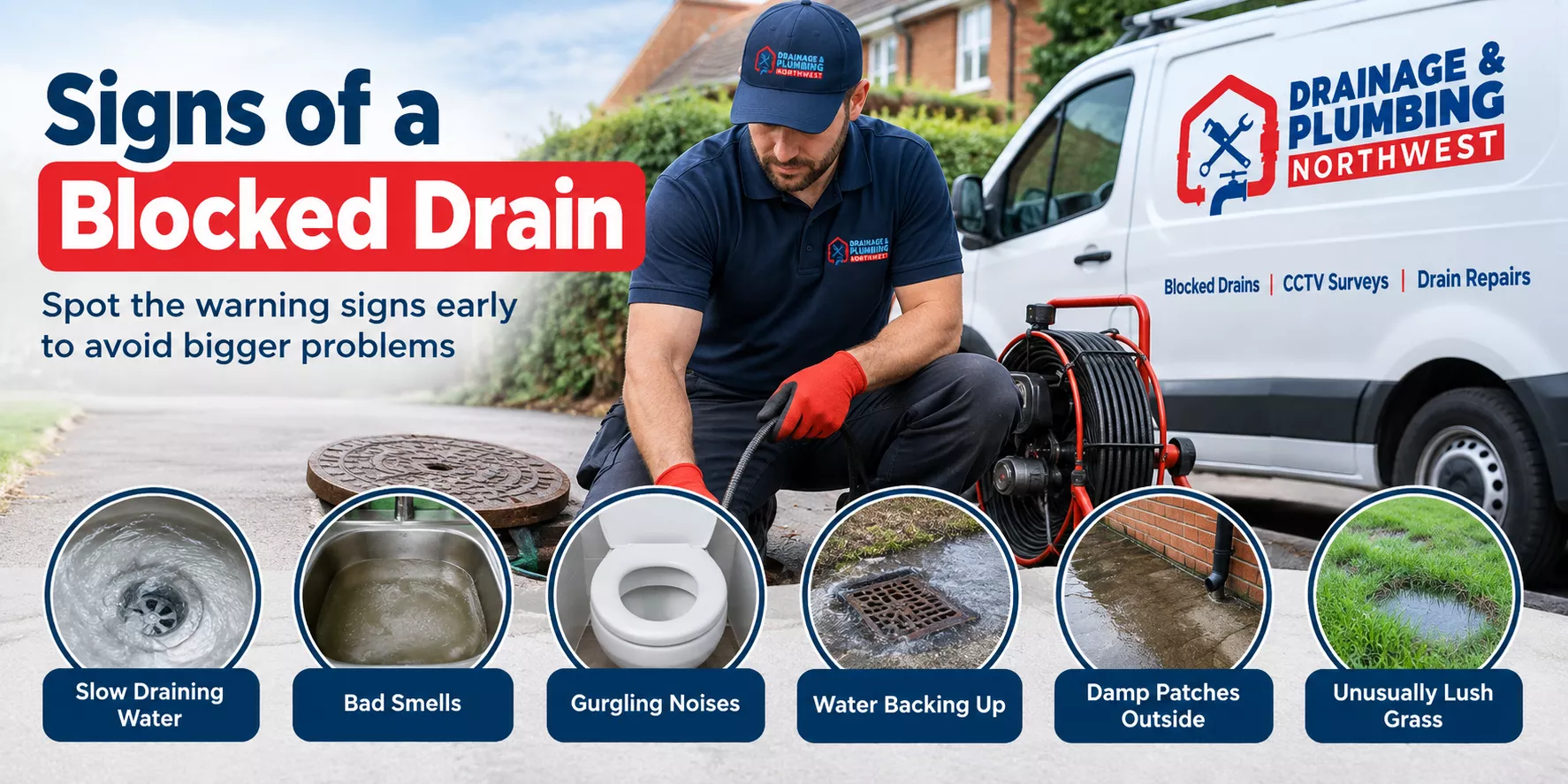
Warning signs of a developing or recurring blockage include slow drainage, gurgling sounds, bad smells, rising water levels, standing water, outside drain overflow and several fixtures becoming affected at the same time. If the same sink, toilet, shower or gully keeps blocking after it has already been cleared, the problem is more likely to be deeper in the drainage system or linked to a structural fault.
A CCTV drain survey is often the best next step when a blockage repeatedly returns, as it can distinguish between a simple obstruction and problems such as tree-root ingress, cracked pipes, displaced joints, collapse, scale, rough surfaces or poor fall. This allows the correct long-term treatment to be selected instead of relying on another temporary unblock.
In simple terms, blocked drains usually develop through either material entering and building up inside the pipe or a defect that prevents waste from flowing freely. If the same blockage keeps coming back, the key is to identify and correct the underlying cause rather than repeatedly treating the symptom.
How Does a Drain Become Blocked?
A drain becomes blocked when waste, debris or structural problems restrict the normal flow of wastewater through the pipe. Common causes include fat, oil and grease that cool and harden, food scraps, wet wipes, sanitary products, cotton buds, nappies, condoms, hair and soap scum. These materials can build up, bind together, trap more debris and narrow the pipe. Structural issues such as tree roots, cracked pipes, low spots or “bellies”, and poor pipe gradients can also trap solid waste and cause blockages.
As the obstruction grows, wastewater drains more slowly and may eventually stop flowing. Typical signs include slow-draining sinks or baths, difficulty flushing toilets, bad smells, water backing up and flooding. Most household blockages can be prevented by only flushing pee, poo and toilet paper, while disposing of wipes, sanitary items, cooking fat, oil, grease and food waste correctly.
How Does Waste Build Up Inside Drain Pipes?
Waste builds up inside drain pipes when fat, oil, grease, food scraps, hair, soap scum, biofilm, starches and other debris enter the system and stick to the pipe walls. Grease cools and hardens, hair binds with soap residue, starchy foods such as rice, flour and pasta swell, and biofilm develops on damp surfaces. These sticky or solid deposits trap more particles, form thicker layers and sludge, and gradually narrow the space available for wastewater.
Important factors that accelerate build-up include:
- Fat, oil and grease: solidify and coat the pipe interior.
- Hair and soap scum: bind together into dense clumps.
- Food and starches: become trapped, swell and stick to the pipe.
- Biofilm and organic residue: create sticky layers that capture more waste.
- Poor pipe slope or pipe bellies: slow water flow and allow solids to settle.
- Bends and traps: create areas where residue can become lodged.
As the build-up increases, wastewater flow becomes restricted, causing slow drainage, gurgling sounds, bad odours and eventually water backing up or a complete blockage.
Can a Drain Become Blocked Suddenly?
Yes, a drain can become blocked suddenly, although many clogs develop gradually. An abrupt blockage can happen when a foreign object or non-flushable item becomes lodged in a toilet trap or pipe bend, when fat, oil or grease cools and forms a solid plug, or when an underground pipe collapses, cracks or shifts. In many cases, the drain was already partially restricted by grease, hair, soap, coffee grounds or other debris, and one new item closes the remaining passage.
Common sudden blockage triggers include:
- Foreign objects: toys, bottle caps, cotton buds or sanitary products.
- Wet wipes and paper: can stick together and rapidly plug narrow sections.
- Hair and soap: can form dense clumps that restrict flow.
- Pasta and rice: absorb water, swell and clog pipes.
- Fat, oil and grease: cool, solidify and trap loose debris.
- Structural failure: pipe collapse, major cracks or shifts can stop drainage instantly.
If one sink, toilet or shower is affected, the blockage may be localised. If several drains back up at once, the problem may be in a main or shared drain.
Why Do Some Blockages Develop Slowly?
Some drain blockages develop slowly because small amounts of fat, oil, grease, food residue, hair, soap scum, biofilm and other debris build up little by little inside the pipe. Sticky deposits coat the pipe walls and trap more material, while poor gradients, bends, traps and pipe bellies slow the flow of wastewater and allow solids to settle. As these layers thicken, the pipe gradually narrows rather than becoming blocked all at once.
Key reasons slow blockages form include:
- Repeated deposition: small amounts of waste accumulate over time.
- Material trapping: grease, soap and biofilm catch hair, food and debris.
- Sedimentation: slow-moving water allows solids to settle in low spots.
- Progressive narrowing: thicker deposits reduce the space available for wastewater.
- Delayed symptoms: water can still pass through a partial blockage, so early signs may be mild.
- Partial-to-complete blockage: continued build-up can eventually close the remaining passage and create a full obstruction.
Typical warning signs include slow drainage, gurgling sounds and bad odours before the drain becomes completely blocked.
What Are the Most Common Causes of Blocked Drains?
The most common causes of blocked drains are fat, oil and grease (FOG), food waste, hair, soap residue, wet wipes, sanitary products, excess toilet paper, foreign objects, outdoor debris, tree roots and limescale. In kitchens, FOG cools and hardens on pipe walls, trapping food scraps, pasta, rice and coffee grounds. Hair and soap scum commonly combine into sticky clumps in bathroom drains, while wipes, cotton buds, sanitary items and thick toilet paper can remain intact and create dense physical obstructions.
Outdoor drains are often blocked by leaves, mud, silt and dirt washed into gullies and surface drains, especially during heavy rain. Tree roots can also enter cracked or leaking underground pipes, where they restrict flow and cause structural damage. In hard-water areas, mineral and limescale deposits gradually reduce the pipe diameter. These causes lead to blockage through accumulation, solidification, swelling, clumping, sedimentation, pipe narrowing or direct obstruction, eventually causing slow drainage, backups, overflow and possible water damage.
Fat, Oil and Grease
Fat, oil and grease (FOG) are common cooking and food-preparation wastes that can cause serious drain and sewer blockages. Sources include cooking oil, butter, lard, meat fats, dairy products, gravy, sauces and greasy food residue. When FOG is poured or washed down a sink, it cools, hardens or congeals inside the pipe, sticks to the pipe walls and traps food particles and other debris. Over time, these deposits become thicker, narrow the pipe and restrict wastewater flow.
Important aspects include:
- How blockages form: FOG cools, solidifies and clings to pipe interiors.
- What makes them worse: food scraps, soap and other debris stick to grease deposits.
- Main consequences: slow drainage, sink blockages, sewer blockages, backups, flooding and fatbergs.
- Boiling water is not a fix: it may only move grease further down the pipe before it cools and congeals.
- Prevention: scrape and dry-wipe greasy plates and pans, use sink strainers, collect cooled grease in a container and put it in the bin.
- Commercial control: restaurants and food businesses should use and regularly maintain grease traps or interceptors.
Wet Wipes and Sanitary Products
Wet wipes and sanitary products can contribute to drain and sewer blockages when they are flushed instead of disposed of correctly. Even wipes labelled “flushable” or “biodegradable” may remain intact long enough to collect with other waste and form obstructions, unlike ordinary toilet paper. Plastic-containing wipes can also create wider environmental problems if they enter sewer systems and waterways.
Important aspects include:
- Do not flush wipes or sanitary products: place them in the bin instead.
- Follow the three Ps rule: only pee, poo and toilet paper should go down the toilet.
- Check product labels: plastic-free or biodegradable materials may be environmentally preferable, but they should still not automatically be treated as flushable.
- Consider reusable options: period pants and cloth pads can reduce reliance on disposable sanitary products.
- Main risk: flushed wipes and hygiene products can contribute to dense drain or sewer blockages and increase the risk of backups.
Hair and Soap Build-Up
Hair and soap build-up forms when loose hair enters a sink, bath or shower drain, tangles into dense clumps and traps soap scum, skin oils, limescale and other debris. Soap residue acts like a sticky binder, while hard-water minerals such as calcium and magnesium can increase soap-scum and limescale deposits. As this material sticks to the pipe walls, the internal surface becomes rougher, catches even more debris and progressively narrows the passage for wastewater. The result is usually slow drainage, gurgling, unpleasant odours, standing water and, in severe cases, a complete blockage.
Important aspects include:
- Main cause: tangled hair forms a net that catches soap scum, oils, limescale and debris.
- Why it worsens: sticky residue and rough pipe surfaces create more snagging points.
- Hard water: calcium, magnesium and limescale can increase soap-scum build-up.
- Warning signs: progressively slower drainage, gurgling, bad smells and standing water.
- Prevention: use a hair catcher or mesh cover, brush long hair before showering, rinse away fresh soap residue and descale in hard-water areas.
- Removal: physical hair removal with a zip tool or drain snake is usually more effective for dense clogs, while baking soda and vinegar is better suited to mild soap scum and maintenance.
Food Waste and Coffee Grounds
Food waste and coffee grounds are common forms of organic kitchen waste that should not be washed down the sink. Coffee grounds do not dissolve in water, so they can settle inside pipework and combine with fats, oils, grease and other food residue. Over time, these materials can form dense, sticky or sludge-like deposits that narrow the pipe, restrict wastewater flow and create stubborn kitchen drain blockages.
The safest approach is to keep coffee grounds and other food waste out of the drainage system altogether. Cooled grounds can be placed in a council food waste caddy, home compost bin or general rubbish where no separate collection exists. Coffee grounds are also useful as a nitrogen-rich compost material and can be mixed with dry materials such as shredded cardboard or leaves.
Collected food waste may be processed through anaerobic digestion, where it can be converted into energy and agricultural fertiliser. Businesses producing large volumes of coffee grounds can also use specialist recycling schemes that turn spent grounds into products such as eco-fuel, animal feed or soil enhancers.
In short, coffee grounds cause drainage problems because they remain solid, settle, mix with grease, form dense deposits and restrict water flow. Correct disposal, composting, recycling and reuse are the best ways to prevent food-waste-related drain blockages.
Foreign Objects
Foreign objects can create direct physical blockages when they accidentally enter sinks, baths, toilets or overflow openings. Small toys, keys, cotton buds and other solid items can become lodged in pipe bends, corners, traps or narrowed sections. An object that might pass through a completely clear drain can become caught on existing hair, grease, wipes or other debris, turning a partial obstruction into a more serious blockage. Once lodged, rigid items can also trap additional waste and make the obstruction increasingly difficult to clear.
In short, the most common blocked drain causes are fat, oil and grease; wet wipes and sanitary products; hair and soap; food waste and coffee grounds; and foreign objects. These materials create blockages by solidifying, sticking, clumping, swelling, settling or becoming lodged, which gradually or suddenly narrows the pipe and prevents wastewater from flowing freely.
What Causes Underground Drain Blockages?
Underground drain blockages are commonly caused by structural pipe damage, tree root intrusion, poor gradients, and the gradual build-up of waste and debris. Cracked, misaligned, sagging or collapsed pipes can interrupt normal wastewater flow, while tree roots can enter through damaged joints and grow inside the pipe. Pipe bellies and low spots also allow water, sludge and sediment to collect instead of draining away.
Internal waste is another major cause. Fat, oil and grease (FOG) can cool, harden and stick to pipe walls, while wet wipes, sanitary products, cotton buds and excess toilet paper can form solid masses that do not break down easily. Hair and soap can combine into sticky clumps, while food scraps such as pasta and rice may swell after absorbing water. Coffee grounds do not dissolve and can settle in pipe bends and corners, adding to existing deposits.
Outdoor debris can also contribute to underground blockages. Heavy rain may wash leaves, moss, dirt and silt into exterior drains and gullies, where they settle into thick sediment layers. Small foreign objects and undissolved bath products can also become lodged in bends or catch on existing debris, making partial blockages worse.
Many underground blockages are therefore composite obstructions, where grease, wipes, hair, soap, food waste, coffee grounds, silt and other materials build up together. As the pipe becomes progressively narrower, common warning signs include slow drainage, gurgling sounds, foul smells, wastewater backup and external overflow. Recurring or hidden blockages may require a CCTV drain survey, while stubborn internal build-up may be cleared using high-pressure water jetting.
Tree Root Intrusion
Tree root intrusion occurs when roots enter underground drain or sewer pipes through tiny cracks, loose joints, or damaged sections. Once inside, the roots continue growing into dense masses that restrict wastewater flow and can trap other debris, making the blockage progressively worse. Common warning signs include slow drains, gurgling or bubbling sounds, frequent clogs, repeated toilet backups, and sewage odours, especially when normal plunging or snaking only provides temporary relief.
Important aspects include:
- Entry points: cracks, loose joints, damaged connections and structural weaknesses.
- Blockage mechanism: roots grow inside the pipe, form dense masses and restrict water flow.
- Warning signs: slow drainage, gurgling, recurring clogs, backups and bad smells.
- Diagnosis: a CCTV drain survey can locate root intrusion and identify pipe damage.
- Removal: hydro jetting or high-pressure water cleaning may clear dense root growth.
- Long-term repair: damaged pipes may require trenchless lining, structural repair, excavation or replacement to stop roots returning.
Scale and Mineral Deposits
Scale and mineral deposits are hard, chalky coatings that form when minerals in hard water—mainly calcium and magnesium—precipitate out of the water and stick to surfaces. Limescale, usually made largely from calcium carbonate, commonly builds up inside pipes, taps, showerheads, kettles, boilers and heating systems. Heating, evaporation, pressure changes and certain water chemistry conditions can accelerate this process. As deposits thicken, they fur up pipework, narrow the internal diameter, restrict water flow, reduce pressure and, in severe cases, contribute to complete blockages.
Important aspects include:
- Main cause: hard water containing dissolved calcium, magnesium and other minerals.
- Common deposits: calcium carbonate, magnesium scale, silicates and phosphates.
- Formation: minerals precipitate due to heating, evaporation, pressure or chemical changes.
- Main effects: pipe narrowing, restricted flow, reduced pressure, lower heat-transfer efficiency and higher energy use.
- Long-term risks: increased maintenance, premature wear, equipment failure and bacterial harbourage on rough scale surfaces.
- Prevention: water softeners, ion-exchange systems, scale inhibitors and regular maintenance.
- Removal: descaling agents, acid-based cleaners and commercial scale-removal solutions.
Leaves, Mud and Silt
Leaves, mud and silt commonly build up in outdoor drains, gullies, yards and ponds. Fallen leaves and dead vegetation provide organic debris, while heavy rain and surface runoff wash soil, clay, dust and fine silt into drainage areas. Silt remains suspended while water is moving, but settles in slow-flow sections, where it mixes with mud and decomposing leaves to form waterlogged sediment, wet muck and organic sludge.
As more material accumulates, the sediment becomes thicker and denser, restricting the space available for water to flow. This can contribute to blocked patio drains, overflowing gullies, poor surface drainage and flooding. Heavy organic build-up may also create low-oxygen sludge and foul or rotten-egg odours as vegetation continues to decay.
Prevention focuses on regularly removing fallen leaves and dead vegetation, keeping drains and gullies clear, and stopping muddy runoff from washing into the drainage system. Existing deposits can be cleared by removing coarse debris manually, carefully loosening dense layers with drain rods, and flushing or extracting remaining sediment. Removed mud and silt should be disposed of properly rather than washed into another drain or watercourse.
Displaced Pipe Joints
Displaced pipe joints occur when two connected drainage pipe sections move out of alignment, creating an internal step, ledge or open gap. This usually develops gradually due to ground movement, subsidence, soil settlement, traffic vibration, external loading, ageing rubber seals or cracked mortar joints. Once a gap forms, wastewater can leak into the surrounding soil, causing subsoil erosion and loss of pipe support, which may make the displacement worse. Escaping moisture can also attract tree roots, while the uneven internal edge catches grease, wipes, sanitary waste, food debris and silt, progressively reducing the pipe diameter and restricting wastewater flow.
Important aspects include:
- Common causes: ground movement, subsidence, ageing seals, soil erosion and repeated external loading.
- Main effects: wastewater leakage, loss of support, root ingress, debris snagging and restricted flow.
- Warning signs: slow drainage, recurring blockages in the same location, foul odours, damp or soft ground and surface depressions.
- Diagnosis: a CCTV drain survey can identify misalignment, open joints, cracks, root entry and the severity of displacement.
- Repair: minor defects may be fixed with localised patch lining or resin/epoxy lining, while multiple damaged joints may require full relining. Severely displaced, separated, unsupported or collapsed pipes may need excavation, realignment or replacement.
Because repeated drain clearing only removes trapped debris and does not correct the displaced joint itself, recurring problems usually require the underlying structural defect to be repaired.
Cracked Drain Pipes
Cracked drain pipes can develop through ageing, corrosion, ground movement, settlement, subsidence, tree-root pressure, chemical deterioration or general wear and tear. Damage may appear as hairline, lateral or longitudinal cracks, holes or full pipe fractures. Once the pipe wall is compromised, wastewater can leak into the surrounding ground, while rough or damaged sections may also contribute to restricted flow and recurring blockages.
Common warning signs include foul odours, slow drainage, gurgling toilets, wet patches, soggy or sunken ground, unusually lush grass and pest activity. Persistent underground leakage can saturate the surrounding soil and contribute to ground settlement, subsidence or sinkholes, while moisture reaching the building may cause damp walls or floors, water staining, mould, wood rot and, in more serious cases, structural cracking.
A CCTV drain survey is one of the most effective ways to confirm the location and severity of hidden pipe damage. Minor accessible cracks may be temporarily patched with epoxy putty or waterproof rubber tape, while suitable underground defects can be repaired permanently using drain relining, no-dig technology or slip lining. Severely fractured or broken pipes may require excavation, removal of the damaged section and fitting of a replacement pipe using flexible rubber couplings or Flexi-seals. Early diagnosis and prompt repair help prevent a small crack from progressing into more serious leakage, blockage, ground movement or structural damage.
Collapsed Drains
A collapsed drain is a serious underground pipe failure where the drain cracks, deforms, partially caves in or breaks completely, restricting or blocking wastewater flow. Common causes include ageing clay or cast-iron pipes, tree root ingress, ground movement, subsidence, soil shifting and heavy traffic loading. Typical warning signs include recurring blockages that return after rodding, slow drainage across multiple fixtures, sewage backup, persistent raw sewage smells, damp or mould, muddy or unusually wet ground, sinking patios or driveways, pest activity and, in severe cases, wall cracks or sagging floors. Leakage from the collapsed section can wash away supporting soil, create underground voids and contribute to subsidence or foundation instability.
Important aspects include:
- Diagnosis: a CCTV drain survey can confirm the exact location, cause and severity of the collapse and distinguish it from a simple blockage.
- Minor or partial damage: may sometimes be treated with fibreglass/resin patching, drain relining or other trenchless repairs.
- Severe collapse: usually requires excavation and pipe replacement.
- Key risks: sewage leakage, contamination, soil erosion, sinking ground, structural damage and pest ingress.
- Recurring blockages: repeated clearing may only provide temporary relief if the collapsed pipe itself remains the obstruction.
- Responsibility: private drains serving one property are generally the homeowner’s responsibility, while some shared or lateral drains may fall to the water company.
- Early action: prompt professional assessment can reduce further structural damage, disruption and repair costs.
Poor Drainage Gradients
Poor drainage gradients occur when pipes are laid too flat, too steep, unevenly, or with a backfall, preventing gravity from moving water and waste efficiently. A slope that is too shallow reduces flow velocity, allowing solids to settle and build up until they cause a blockage, while an excessively steep slope can let water outrun solid waste, leaving material stranded and prone to hardening. The correct gradient depends on pipe diameter, expected flow, connected appliances and whether the system carries foul or surface water. Problems can also arise from bowed plastic pipes, poor bedding, inaccurate invert levels or poor installation, all of which can create local dips or reverse falls.
Important aspects include:
- Too flat: slow flow → solids settle → deposits build up → blockage.
- Too steep: water moves too quickly → solids are left behind → waste hardens → blockage.
- Correct design: maintain an even, constant gradient matched to pipe size and flow.
- Common reference gradients: 100mm foul drains may use 1:40 or 1:80 depending on flow conditions, while larger 150mm pipes may allow 1:150 under suitable conditions.
- Measurement: use invert levels, inspection chambers, a 1200mm spirit level, taut/string line or laser level to check the fall.
- Installation risks: bowed pipes, poor granular bedding and inaccurate levels can create backfalls or uneven gradients.
- Steep sites: a backdrop manhole or vertical drop section can manage major level changes without making the horizontal drain too steep.
- Where gravity cannot work: a pumping installation may be required instead of forcing an unsuitable gradient.
- Best practice: competent design, good workmanship and correct testing are essential to prevent recurring drainage failures.
Do Different Drains Block for Different Reasons?
Yes, different drains block for different reasons because they handle different types of waste and face different conditions. Kitchen drains are mainly affected by fats, oils and grease (FOG), food particles, starchy foods and coffee grounds. Grease can cool and solidify on the pipe walls, creating a sticky layer that traps food waste and gradually narrows the pipe.
Bathroom sinks, showers and baths are more likely to block because of hair, soap scum, cosmetic products and mineral scale. Hair tangles and binds with sticky residue, then catches around bends, drain traps and pop-up mechanisms, creating a dense obstruction over time.
Toilets and sewer lines commonly block because of wet wipes, sanitary products, nappies and thick or excessive paper. These materials do not break down like normal toilet paper, so they can snag on pipe joints, combine with grease and form larger, more persistent blockages.
Outdoor and surface-water drains are usually affected by leaves, soil, dirt and other debris carried in by storm runoff. Tree roots can also enter tiny cracks or weak pipe joints in search of moisture, where they grow inside the drain and restrict flow. In short, the likely cause depends on the drain type: FOG and food waste in kitchens, hair and soap in bathrooms, non-flushables in toilets and sewers, and leaves, soil, runoff and roots in outdoor drains.
Kitchen Drains
Kitchen drains carry wastewater from the sink through the strainer, tailpiece, P-trap and waste pipe into the wider household drainage system. The strainer catches larger food scraps, while the P-trap holds a water seal that helps stop sewer gases entering the kitchen. The most common problems come from fats, oils and grease (FOG), food particles, organic residue and bacterial build-up. Grease can stick to pipe walls, trap more debris and gradually narrow the flow path, leading to slow drainage, foul odours, partial blockages and, in severe cases, wastewater backflow.
Important aspects include:
- Prevention: use a strainer or drain screen, keep FOG out of the sink, and wipe greasy dishes before washing.
- Minor cleaning: the sources mention baking soda, white vinegar, hot water and biological cleaners for odours and organic residue.
- Accessible clogs: a plunger or manual P-trap cleaning may remove local blockages.
- Deep clogs: use an auger or plumber’s snake carefully, then run water to test whether flow has returned.
- Maintenance: regularly clean the strainer, stopper and accessible pipework to reduce grime and grease build-up.
- Persistent problems: repeated blockage, complete loss of flow or wastewater regurgitation may require professional drain unblocking rather than repeated DIY attempts.
Bathroom Drains
Bathroom drains remove wastewater from sinks, showers and floor areas through the drain outlet, P-trap, trap arm and waste pipe before it reaches the main wastewater line. The P-trap holds a small water seal that helps stop sewer gases and unpleasant smells entering the bathroom. Different bathroom drains may use push pop-ups, lift rods, grid drains, point drains or linear drains, but all rely on a clear flow path to work properly.
The most common bathroom drain problems are caused by hair, soap scum, cosmetic residue, mineral scale and general debris. Hair tangles and combines with sticky residue around sink stoppers, P-traps and pipe bends, gradually restricting flow and causing slow drainage or blockages. Restricted flow can leave water stagnant, creating warm, moist conditions where bacteria multiply and release gases that cause foul odours. Persistent or severe smells, especially when combined with recurring clogs, may indicate a deeper blockage or sewer-line issue.
Basic maintenance includes removing visible hair and debris, cleaning the P-trap, using a drain snake for accessible clogs, and flushing loosened residue away. The supplied sources also suggest baking soda and vinegar followed by hot water for minor odour and build-up problems. Drain covers or hair catchers, regular cleaning and keeping grease or oil out of the drainage system can help prevent future clogs.
Good bathroom ventilation also helps control moisture and general odours, so extractor fans or open windows are useful after bathing or showering. If a bathroom drain continues to smell, drain slowly or repeatedly block after cleaning, a professional plumber may be needed to identify the underlying cause and provide a longer-term solution.
Toilets
Toilets are an important bathroom fixture that influence both practicality and the overall appearance of the space. Common options include close coupled, back to wall, wall hung, comfort height and rimless toilets, allowing homeowners to choose a design that suits the bathroom layout, available space and personal preference. The source describes these toilets as being made from durable ceramic with a clean finish, making them suitable for a range of bathroom styles.
Important aspects include:
- Close coupled toilets: a common, practical bathroom configuration.
- Back to wall toilets: suited to a neat, streamlined layout.
- Wall hung toilets: a modern option for contemporary spaces.
- Comfort height toilets: provide a taller seating position.
- Rimless toilets: offer an alternative modern toilet design.
- Suitable spaces: can be used in family bathrooms, en-suites and cloakrooms.
- Material: durable ceramic with a clean finish.
- Selection factors: bathroom size, layout, style and user preference.
Outside Drains and Gullies
Outside drains and gullies collect rainwater, surface water and correctly connected greywater from roofs, gardens, patios, paths and driveways, then direct it into the underground drainage system. A typical gully uses a grate or grid to catch larger debris, a chamber to collect water, and a water trap that forms a seal against sewer gases and unpleasant odours. Common types include P-trap gullies, bottle gullies, back-inlet gullies and channel drains. Blockages usually develop when leaves, twigs, moss, mud, silt, grease, soap residue and other organic debris accumulate, compact and restrict flow, leading to slow drainage, water backup, overflowing gullies, standing water, gurgling and foul smells. Heavy rain, clay soil, sloping ground, hardstanding and wooded surroundings can increase runoff and blockage risk.
Regular maintenance helps keep outside drainage working properly. Clear gutters and grids, remove leaves and silt, inspect drains after heavy rain, maintain leaf guards, control vegetation and reduce soil erosion around drainage points. Accessible debris can often be removed manually, while pressure washing, plungers or drain rods may help with suitable blockages. Persistent standing water, recurring overflow or drainage smells may indicate a deeper blockage or damaged underground pipework, in which case a professional drainage inspection or CCTV survey may be required.
Main Underground Drains
Main underground drains carry foul wastewater and surface water away from a property through buried gravity pipework towards a public sewer or treatment plant. For domestic systems, 110mm PVC-u pipes are commonly used, while 160mm pipes suit higher-capacity, commercial or shared drainage runs. Correct installation depends on a suitable fall or gradient, stable granular bedding or pea shingle, and accessible inspection chambers or manholes so wastewater can flow efficiently and the system can be inspected or maintained.
Important aspects include:
- Pipe sizes: 110mm for most domestic systems; 160mm for higher-capacity or shared runs.
- Material: durable orange PVC-u for buried gravity drainage.
- Gradient: the source gives a typical foul-drain fall of 1 in 40 to support self-cleansing flow.
- Bedding: granular material such as pea shingle helps support the pipe and distribute loads.
- Access: inspection chambers or manholes are used at junctions, direction changes and gradient changes.
- Connections: rainwater and toilet foul connections must be routed appropriately.
- Planning factors: drain depth, pipe diameter, gradient, wastewater type and regulatory requirements should be considered for new runs, repairs or extension connections.
Why Does My Drain Keep Blocking?
A drain that keeps blocking usually has an underlying problem that has not been fully removed or repaired. A previous clog may have been only partially cleared, leaving material behind for new debris to attach to. In kitchens, recurring blockages are commonly caused by fats, oils and grease (FOG), food waste and coffee grounds; grease cools and hardens inside the pipe, creating a sticky layer that traps more waste. In bathrooms, hair and soap scum can form dense clumps, while toilets may repeatedly block when wet wipes, cotton wool, sanitary products or other non-flushable items become lodged in the trap or pipework. Outside drains can also clog with leaves, mud and organic debris.
Recurring problems may also be caused by deeper structural faults such as tree-root intrusion, cracked pipes, pipe bellies, sagging sections or crushed pipework. These defects create permanent low spots or catch points where waste continues to collect, so ordinary unblocking may only provide temporary relief. Warning signs include slow drainage, gurgling, unpleasant odours, water backup, high toilet water levels or multiple fixtures blocking at once. Prevention includes keeping FOG and food out of kitchen sinks, using hair catchers, flushing only toilet paper, and clearing outdoor debris. If the blockage returns quickly or repeatedly, a CCTV drain survey and professional drainage inspection can identify hidden roots, damaged pipes or deeper main-line problems so the actual cause can be cleared and repaired.
How Can You Identify What Is Causing a Drainage Blockage?
You can often identify the cause of a drainage blockage by looking at the symptoms, checking inspection chambers, noting the feedback you get from drain rods or jetting, and using a CCTV drain inspection where the cause is not obvious. The location and behaviour of the blockage can indicate whether you are dealing with a localised clog, a main drain obstruction, grease or debris build-up, tree roots or a structural defect such as a cracked or collapsed pipe.
Blockage Symptoms
The symptoms usually provide the first clue about where the blockage is and what may be causing it. A single slow drain or one blocked fixture normally points to a localised blockage close to the sink, shower or toilet. Common causes include hair, food particles, soap scum, grease and other debris.
If several fixtures are draining slowly or are blocked at the same time, the obstruction is more likely to be in a shared, main or outside drain. Water that drains increasingly slowly may indicate a developing restriction, while water that does not drain at all can suggest a more severe or complete blockage.
Other useful warning signs include:
- Bad smells: Food, grease, waste and other organic matter may be trapped and decomposing inside the pipework.
- Gurgling sounds: Trapped air being forced through restricted pipework can indicate a partial obstruction.
- Standing water: Water remaining in a fixture or drain can indicate that normal flow has been significantly restricted.
- Recurring symptoms: A blockage that repeatedly returns may point to a deeper problem such as tree roots, heavy deposits or structural damage.
The more symptoms that appear together, such as slow drainage, gurgling and unpleasant smells, the stronger the indication that there is a drainage blockage rather than an isolated fixture problem.
Inspection Chambers
Inspection chambers can help you narrow down the exact section of drain where the blockage is located. Open the nearest accessible chamber and check whether there is standing water, visible debris or normal flow.
If the inspection chamber is full of water, the blockage is likely to be downstream or after that chamber, because wastewater is reaching the chamber but cannot continue through the pipe. If the chamber is empty, the blockage may be upstream or before the chamber, because wastewater is not reaching that point.
Checking several chambers in sequence can make the location clearer. For example, if one chamber is flowing normally but the next is full, the obstruction is likely to be somewhere between those two points. Comparing full, empty and partially filled chambers is therefore a useful way to narrow down the blockage location before carrying out further clearance work.
Feedback From Rodding or Jetting
Drain rods and high-pressure water jetting can provide useful feedback about both the location and type of blockage.
When using drain rods, you may feel resistance when the rod reaches the obstruction. The point where the rods stop or become difficult to push can help indicate the blockage position. If the rods pass through and break up the obstruction relatively easily, the cause may be a softer build-up such as grease, grime, silt or accumulated debris.
The way the drain responds after rodding or jetting is also important. If water begins to flow more freely, the blockage is probably being cleared. If normal flow returns after flushing fresh water through the drain, the obstruction has likely been successfully removed.
However, if the rods repeatedly stop at the same point, jetting produces little improvement, or the blockage quickly returns, this may indicate a more serious cause such as:
- tree-root intrusion;
- a displaced pipe joint;
- heavy encrustation;
- a cracked pipe;
- a collapsed section of drain.
In these situations, further investigation is usually needed rather than repeated attempts to force through the obstruction.
CCTV Drain Inspection
A CCTV drain inspection is one of the most accurate ways to identify the exact cause of a difficult or recurring drainage blockage. A small camera is passed through the pipework so the inside of the drainage system can be inspected directly.
CCTV can identify both the location and nature of problems that cannot always be confirmed through symptoms, inspection chambers or rodding alone. It can reveal issues such as:
- cracks and fractures;
- collapsed pipe sections;
- displaced joints;
- tree-root damage;
- heavy grease or debris build-up;
- structural defects;
- recurring obstruction points.
A CCTV survey is particularly useful where a blockage keeps returning, is located deep within the system or does not respond properly to rodding or jetting. By identifying the exact location and underlying cause, the inspection makes it easier to decide whether the drain simply needs clearing or whether repair work is required.
Can the Cause of a Blockage Determine the Best Treatment?
Yes. The cause, symptoms and location of a drainage blockage determine the most suitable treatment. A local blockage caused by hair, soap scum or food waste may only need manual removal, plunging or light mechanical clearance. Deeper grease, silt or grime build-up may need rodding or high-pressure water jetting, while tree roots, cracked pipes and collapsed drains usually require CCTV inspection followed by specialist repair.
A blockage affecting one sink, toilet, bath or shower is usually close to that fixture. If several fixtures in one property are affected, the problem may be in a private external drain. If neighbouring properties are also experiencing slow drainage, backing up or flooding, the obstruction may be in a shared or public sewer.
Cause, Typical Sign, Likely Location and Common Treatment
| Cause | Typical Sign | Likely Location | Common Treatment |
| Fats, oils and grease | Slow drainage, smells, recurring kitchen blockage | Kitchen waste pipe or downstream drain | High-pressure water jetting for significant build-up |
| Food and organic waste | Slow sink drainage, unpleasant odours | Sink trap or nearby waste pipe | Remove debris or use mechanical clearance |
| Hair and soap scum | Slow bath, basin or shower | Near plughole, trap or bathroom pipe | Manual removal, hair tool or plunger |
| Wet wipes and sanitary products | Difficult flushing, recurring blockage, backing up | Toilet, soil pipe or drain | Rods, augers or professional physical removal |
| Excessive toilet paper | Slow flushing, water rises before draining | Toilet trap or soil pipe | Plunging or mechanical clearance |
| Sand, cement or building debris | Sudden hard blockage, little or no flow | U-bend or nearby pipe | Mechanical or specialist removal |
| Grease, silt or grime | Gradually worsening flow, improvement after rodding or jetting | Waste pipe or external drain | Rodding or high-pressure jetting |
| Tree roots | Recurring blockage, rodding resistance | Underground external drain | Root cutting or jetting, CCTV inspection and repair |
| Cracked or displaced pipe | Blockage keeps returning, resistance at same point | Underground drain or sewer | CCTV inspection followed by repair or relining |
| Collapsed pipe | Severe blockage, little or no flow | Buried drainage pipe | CCTV inspection and structural repair or replacement |
| Single-fixture blockage | Only one fixture affected | Close to the fixture | Local mechanical clearance or plumber |
| Private external drain blockage | Several fixtures in one home affected | Private drain serving one property | Drainage contractor using rodding, jetting or CCTV |
| Shared/public sewer blockage | Several properties affected or external flooding | Shared or public sewer | Report to the responsible sewerage provider |
| Unknown or recurring blockage | Cause unclear or blockage repeatedly returns | Anywhere in the drainage system | CCTV survey to identify the exact cause and location |
Soft, localised blockages are normally easier to clear. Hair, soap scum, food and small amounts of debris often sit close to a fixture and may respond to plunging or manual removal. Hardened grease and accumulated silt tend to form deeper in the drainage system and are more likely to require professional jetting.
Physical obstructions such as wet wipes, sanitary items and excessive toilet paper usually need mechanical removal because they do not dissolve easily. If the blockage is deeper in the pipework, rods, augers or professional clearance may be required.
Repeated resistance during rodding, temporary improvement after jetting, or a blockage that quickly returns can indicate tree roots or structural damage. In these cases, a CCTV drain inspection is the best way to identify cracks, displaced joints, root intrusion or collapsed pipework before deciding whether the drain needs repair, relining or replacement.
The blockage location also determines who should deal with it. Internal plumbing problems generally require a plumber, private external drains usually require a drainage contractor, and shared or public sewer blockages should be reported to the responsible sewerage provider. Matching the treatment to the cause and location helps avoid ineffective work and reduces the risk of further damage.
How Can You Prevent the Same Cause From Blocking the Drain Again?
To prevent the same drain blockage from returning, focus on the root cause rather than repeatedly clearing the symptom. If the problem is caused by fat, oil and grease (FOG), keep it out of kitchen sinks; if it is caused by food, hair or soap debris, use strainers and hair catchers; and if wet wipes, sanitary products or paper towels caused the blockage, keep them out of toilets. A blockage that returns quickly after clearing can indicate incomplete clearance, residual build-up or a deeper structural fault.
Important prevention steps include:
- FOG: cool and bin cooking fat, and wipe greasy pans before washing.
- Food and hair: use fine-mesh strainers and clear shower wastes regularly.
- Non-flushables: never flush wipes, sanitary products, paper towels or foreign objects.
- Warning signs: act on slow drainage, gurgling, bad smells, standing water or repeat overflow.
- Recurring same-spot blockage: arrange a CCTV drain survey to check for roots, cracks, displaced joints, collapse, scale or poor gradient.
- Structural causes: remove roots and repair their entry point; fix cracked, displaced or collapsed pipework; correct poor drainage fall where necessary.